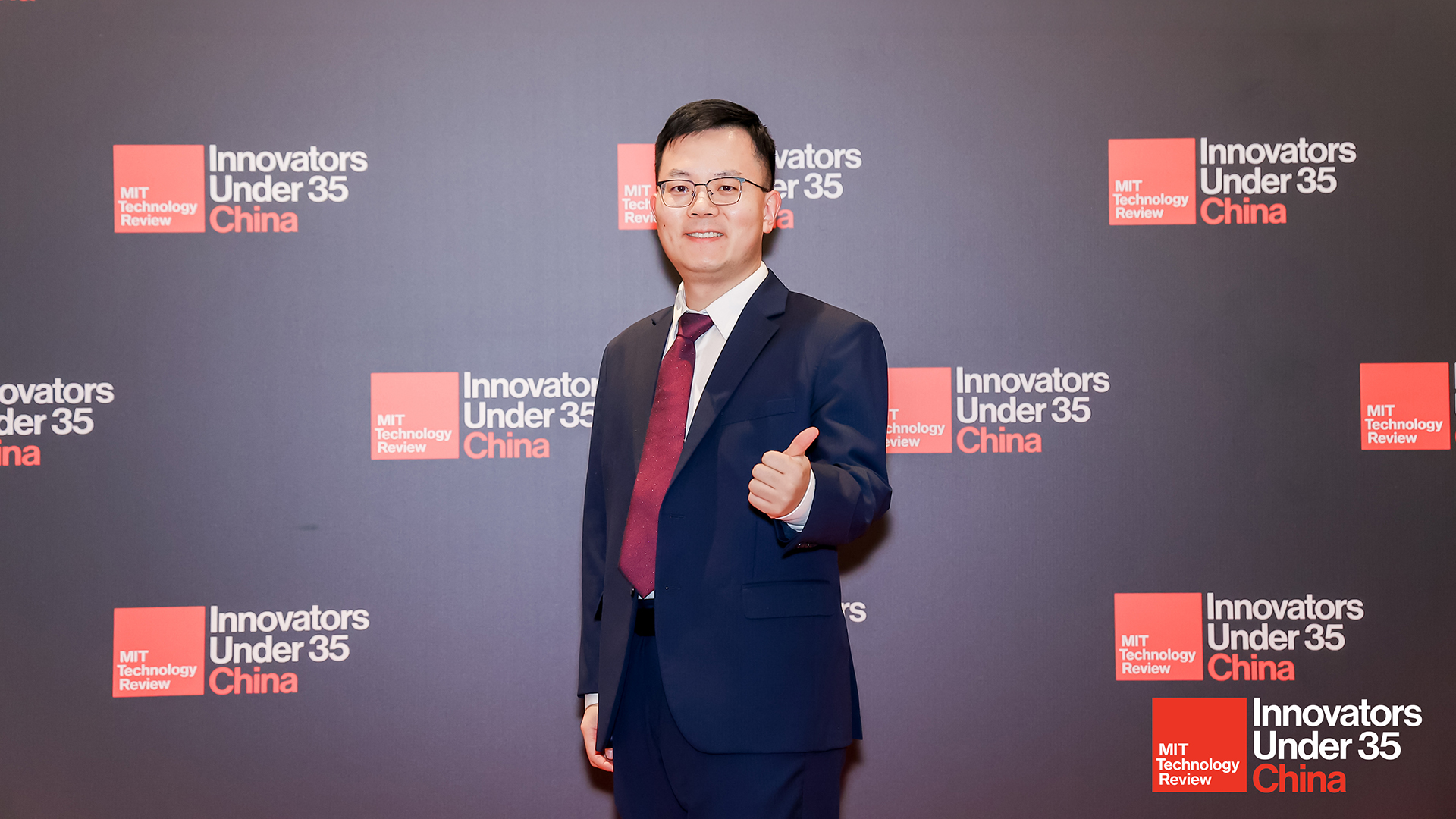
In recognition of his contributions to cutting-edge artificial intelligence research, Professor Hengshuang Zhao of the HKU School of Computing and Data Science has been selected as one of the 2025 ‘35 Innovators Under 35 China’ (TR35 China) in the ‘Pioneers’ category by MIT Technology Review, a globally respected technology publication founded by the Massachusetts Institute of Technology (MIT).
The prestigious ‘35 Innovators Under 35’ award celebrates exceptional young talent who are pushing technological boundaries. The TR35 China regional selection was launched in 2017 to honour outstanding young scientific and technological leaders in China with international influence. The selection of the 2025 cohort was conducted through rigorous evaluation by a panel of over 50 leading international experts spanning academia, industrial practice, and technological innovation. Professor Zhao’s selection underscores his transformative contributions to AI research and positions HKU at the forefront of global technological development.
Professor Zhao is widely recognised as a pioneer in the emerging domain of Physical Intelligence. His research addresses one of the most vital frontiers in modern computer science: enabling artificial systems to seamlessly perceive, understand, and interact with the physical world around us. Over the course of his career, Professor Zhao has established a unified general framework for Physical Intelligence that bridges two-dimensional and three-dimensional spaces, connects visual perception with deep semantic understanding, and bridges the gap between virtual simulations and physical reality. His work provides a scalable, deployable, and generalisable technical foundation for visual, spatial, and embodied intelligence globally.
His research achievements have already reshaped both academic paradigms and real-world industrial applications. Early in his research journey, Professor Zhao developed PSPNet (Pyramid Scene Parsing Network), which has amassed over 20,000 citations as a foundational framework for semantic segmentation, with applications in fields such as autonomous driving, medical imaging, and environmental monitoring. He later created the Point Transformer series to reshape 3D backbone networks, allowing AI models to process complex, unstructured spatial point clouds with unprecedented accuracy.
In the industrial domain, his Depth Anything series, designed for robust monocular depth estimation, has been integrated into major global ecosystems, including Apple Core ML, bringing real-time physical spatial perception to billions of intelligent consumer devices worldwide. Furthermore, through pioneering systems like DriveGPT4 and GPT4Point, Professor Zhao is advancing artificial intelligence beyond merely perceiving and understanding the environment toward actively reasoning, planning, and transforming physical reality.
Professor Zhao’s path to becoming an internationally recognised AI researcher is marked by rigorous academic training at top-tier institutions around the world. He earned his Bachelor’s degree from Huazhong University of Science and Technology before completing his PhD at the Chinese University of Hong Kong. Seeking to deepen his exploration of machine learning and computer vision, he subsequently undertook prestigious postdoctoral fellowships at two of the world’s leading research hubs: MIT’s Computer Science and Artificial Intelligence Laboratory and the University of Oxford’s Torr Vision Group.
Currently an Assistant Professor at HKU’s School of Computing and Data Science, Professor Zhao’s academic accomplishments have earned him widespread recognition, including the highly competitive Excellent Young Scientists Fund awarded by the National Natural Science Foundation of China, and the AI 2000 Most Influential Scholar Award (Honourable Mention) for five years in a row since 2022.
He is at the helm of the HKU Super Artificial Intelligence Lab (HKU-SAIL), a dynamic research group within the School of Computing and Data Science dedicated to building intelligent visual systems that enable machines to perceive, understand, imagine, and interact with the real world. Under his leadership, HKU-SAIL organises its ambitious research agenda around four interconnected directions: Generative AI, Embodied AI, Multimodal AI, and Spatial AI.
Professor Zhao’s recognition in MIT Technology Review’s ‘35 Innovators Under 35 China’ list for 2025 is both a testament to his past breakthroughs and an exciting preview of what lies ahead. As AI shifts from purely digital interfaces to embodied systems that navigate physical spaces, his work at HKU and HKU-SAIL will play a central role in powering the next generation of autonomous driving, robotics and spatial computing, and redefine how intelligent machines perceive and shape our world.