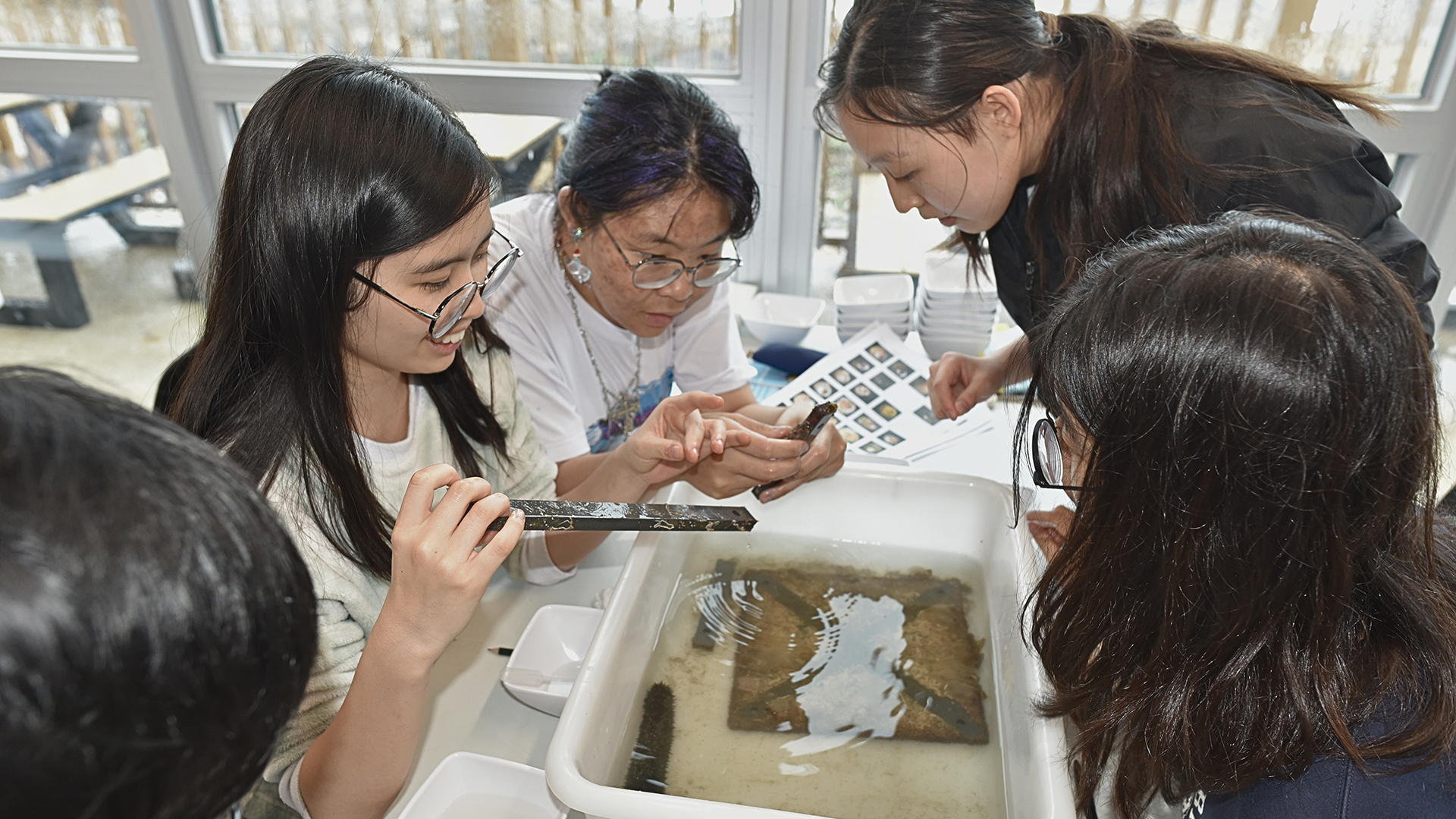
Lolan Chiu is focussed. The tiny shrimp and crabs that she is trying to identify all look very similar, even under a microscope, but she is not giving up. “I want to be a marine scientist. I already have my scuba licence,” declares the Year 12 student from ESF Sha Tin College. “But I did not know how detail-oriented you have to be as a scientist, looking at different species and carefully observing small details in their shapes and patterns! I cannot wait to tell my schoolmates what I’ve learned in this programme.”
The programme that Lolan is taking part in is called ‘Exploring Marine Biodiversity: Empowering Youth Ambassadors for Ocean Stewardship.’ It is organised by HKU’s Swire Institute of Marine Science (SWIMS) and supported by the Environment and Conservation Fund.
The programme started in late February, and the first two cohorts of more than 100 students from over 20 different schools have already completed the four workshops that make up the programme. Two more cohorts will start in September.
Ms Janis Mok, the SWIMS Outreach and Strategic Partnerships Manager who developed the original idea into a successful funding proposal, explains the principle behind it. “Everyone agrees that we must protect our oceans,” says Mok. “But to go beyond buzzwords and good intentions, and actually protect our marine environment, you need to understand it, and that takes learning.”
The programme gives Hong Kong’s secondary school students an opportunity to learn how the marine environment works and how scientists obtain the knowledge needed to make the right decisions to protect it. The students learn by doing – taught by SWIMS scientists, they become scientists themselves, using the same methodology that their instructors use for their own research.
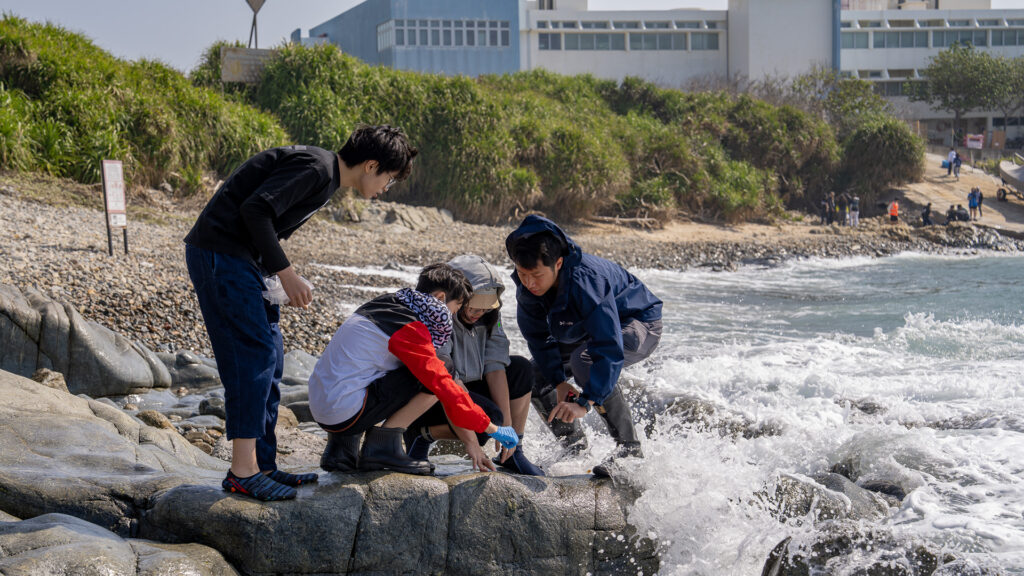
In the classrooms at SWIMS, the students first learn the theory – how marine ecosystems function and the crucial role of biodiversity in this process. Then comes the fieldwork. On the rocky shores of Cape D’Aguilar, in the mangroves of Tai Tam and the coral communities of Hoi Ha Wan Marine Park, the students get to meet Hong Kong’s marine biodiversity face-to-face and learn the techniques to sample and assess it, taking the samples to the laboratories at SWIMS to process and interpret. The students also make a pledge to pass what they learn to others, in their school and beyond, as marine conservation ambassadors.
“Each participating school nominates five students to take part in the programme,” says Mok, noting that the programme has been very well-received. “More than 30 schools – local and international – have signed up, exceeding our expectations.”
“The main attraction is the opportunity for students to do hands-on, experimental learning,” says Mr Gregg Morrison, Western Co-Principal, Secondary, at Yew Chung International School. “I’m very happy to support the programme. We’ve got students who are really passionate about this, so it’s very important that we get them out and give them real-life opportunities.”
Four workshops, each one taking place on a weekend, make up the programme: Discovering Marine Biodiversity, From Genes to Ecosystems, Exploring Coastal Habitats, and Coral Reefs and Ocean Stewardship.
Discovering Marine Biodiversity is based on MarineGEO, a global marine biodiversity survey that SWIMS is part of.
On a cold March afternoon, the students watch Dr Phil Thompson, SWIMS Education and Outreach Officer, get a mask and snorkel and brave the chilly sea to bring out an ARMS (Autonomous Reef Monitoring Structure) that is used to sample biodiversity. In the lab, the students learn how to identify crabs, molluscs, fish, and worms that have colonised the ARMS, and count their abundance, while Dr Thompson and his assistants explain the role each different species plays in the marine ecosystem.
Dr Thompson, a SWIMS alumnus who designed the programme’s curriculum, says, “SWIMS has a 35-year history of being a premier research facility, and I base all of our teaching on the methods that our researchers use, so that the young, interested minds can spread the information that we find in our scientific discoveries.”
One such method is environmental DNA (eDNA), a cutting-edge tool used in biodiversity assessments. It allows scientists to confirm the presence of a species from just fragments of their genetic material in the environment. Students learn eDNA methodology in the From Genes to Ecosystems workshop. First, they collect samples of seawater and biofilm from the rocky shore. Then, in the laboratory, they process the sample to extract the DNA material.
“A very cool experience,” is how Riya Bhatt, Year 11 student from Yew Chung International School calls it. “In a traditional classroom, we don’t get this hands-on experience – collecting samples ourselves, and then using methods that are used by researchers to analyse them!”
Riya also realised that the workshop was a taste of the kind of independent learning that she would soon have to do as a university student. “I did not know how complicated it was to extract DNA – there are more than 20 steps!” she says. “Understanding the instructions was the hardest part. At school, there is a teacher to tell you everything, but here you need to follow written instructions with little guidance. This prepared me for when, in the future, at university, I will be figuring out complicated things myself. Actually, once you understand it, it all seems easy!”
The DNA work is done in a pristine molecular lab, but the Exploring Coastal Habitats workshop takes students into the mangroves, and mud, of Tai Tam. Here, the youngsters get their hands muddy while learning the scientific method – taking samples of biodiversity in a habitat.
“We are randomly placing quadrats to ensure that there is no sampling bias,” explains Dave Kim from ESF Island School, while enthusiastically digging into the mud, excited to find more animals. He clearly knows a great deal about marine fauna. “We already found a massive fiddler crab and a sea slug,” he observed. “If we’re lucky, we can find a pistol shrimp!”
But the hardest part of the programme was not the need for attention to detail, independent learning, or fighting your way through mangrove thicket, notes Dr Anita Soekarno, Head of Science at Creative Secondary School. “Getting up early on a Sunday was the most challenging part for teenage brains! But once the students get here, they enjoy being outdoors, collecting samples and being real scientists.”
Having become scientists, the students now have to fulfil their pledge and become ambassadors, teaching what they have learned to others.
“The next challenge is creating something to bring back to the school, something that will continue within the next generation of students,” says Dr Soekarno. “Let’s see what they come up with!”