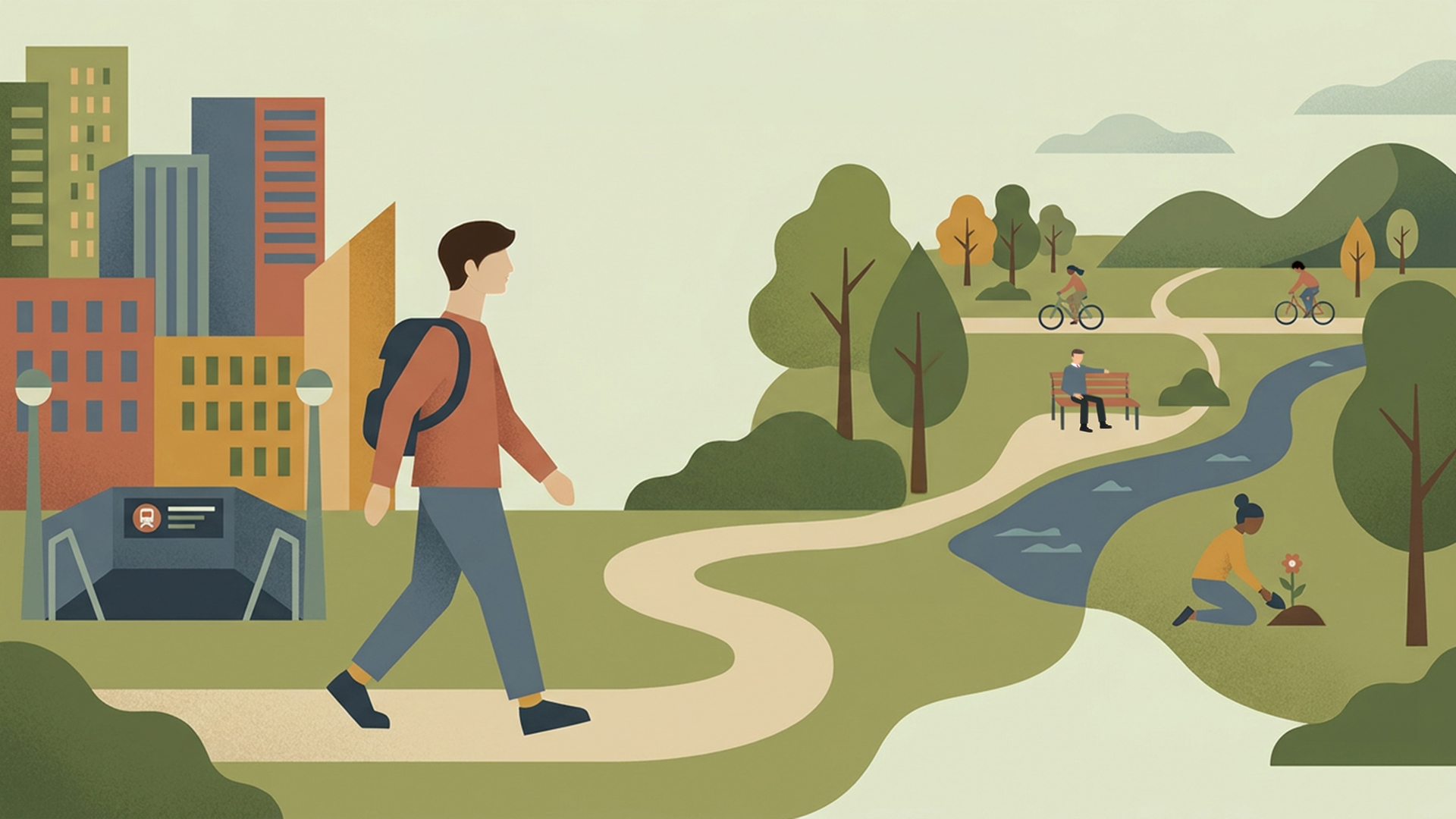
For Hong Kongers and people used to living in a concrete metropolis, getting away to the great outdoors and nature can feel great – a refreshing, rejuvenating experience.
A new HKU study suggests it’s more than just a feeling and even modest weekly contact with green spaces is associated with meaningful mental health benefits. Recently published in the Journal of Environmental Psychology, a leading journal in the field, the study provides scientific evidence and practical guidance for people seeking to integrate nature into everyday life.
The research was led by Professor Bin Jiang from the Urban Environments and Human Health Lab in the HKU Faculty of Architecture, in collaboration with the first author and senior lab member, Dr Jiali Li, and a group of top scientists, including Professor Peng Gong, HKU Vice-President and Pro-Vice-Chancellor (Academic Development), Professor Chris Webster, Chair Professor from the HKU Department of Urban Planning and Design, and Professor Gunter Schumann from Fudan University, Charite University Medicine Berlin and Cambridge University.
Mental health challenges – including stress, anxiety, depression, and chronic negative emotional states – are a genuine and increasingly pressing concern for urban populations worldwide. Globally, over 550 million people are affected by depression and anxiety disorders, which are major contributors to disability, chronic diseases, and economic costs.
At the same time, cities have become denser and less green. By 2050, approximately 70% of the global population, roughly 5.6 billion people, is projected to reside in urban environments. Over recent decades, the physical and structural footprint of cities has expanded more than fivefold, placing enormous strain on both the availability and quality of urban green spaces. Taken together, these trends make a compelling case for promoting green space exposure as a meaningful and practical component of broader, more holistic mental health strategies.
But what exactly does ‘exposure’ mean? The team was careful to look at the issue from the layperson’s perspective and identify benchmarks for ‘intensity’ (the optimal level of greenness required to trigger mental health benefits), ‘duration’ (the ideal number of hours per week one should spend in nature), and ‘frequency’ (the recommended number of visits to green spaces per week.
The team reviewed evidence published between 1980 and 2025, focusing on how often people visit green spaces and how much time they spent there each week. The outcomes they looked for included stress, anxiety, depression and mood.
In separate analyses, around one visit per week or one hour per week was associated with half of the maximum benefit estimated by the respective model. Around four visits or four hours per week corresponded to about 90%, while around six visits or eight hours corresponded to about 99%. The percentages describe a share of the model’s estimated maximum benefit; they do not mean that symptoms improve by those percentages.
The broader pattern that emerges from these findings is an encouraging one: even a modest, manageable level of regular nature contact may already yield meaningful benefits for mental well-being. However, the returns are not linear, as the frequency and duration of nature visits increase, each additional visit or hour tends to contribute progressively smaller additional benefits. In other words, more is not necessarily better.
The study builds on earlier research on ‘greenness intensity’, or how much greenery people encounter in cities, and their findings that a too-green city might be as bad as a too barren a city, and that eye-level greenness, meaning the view encountered in daily urban navigation, was the most effective in producing positive mental health responses.
Together, the studies refine the Dose-of-Nature Framework, which considers how much nature people encounter, how often, for how long and how easily they can reach it. The new findings show that the pattern for frequency and duration differs from that for greenness intensity. Evidence on accessibility remains limited, and further research is needed to understand how green space quality, activities and personal circumstances affect the benefits.
These findings carry clear practical implications for urban planners and designers. Green spaces that are easy to reach and genuinely inviting to use regularly are particularly valuable. Shaded seating, connected paths and well-maintained spaces can help people spend time outdoors. Evaluating green spaces should include considering how people use them as well as how much greenery a city provides.
And for ordinary residents of cities? The findings support building nature contact into daily life through small, sustainable habits that fit naturally into existing routines, such as a weekly stroll through a local park or choosing a greener route to work or school. The reference points can serve as useful starting guides, with room for personal adjustments based on individual health needs, preferences, and available time.
But perhaps the most practical and important step is the most obvious one – simply start by making contact with nature part of daily life.