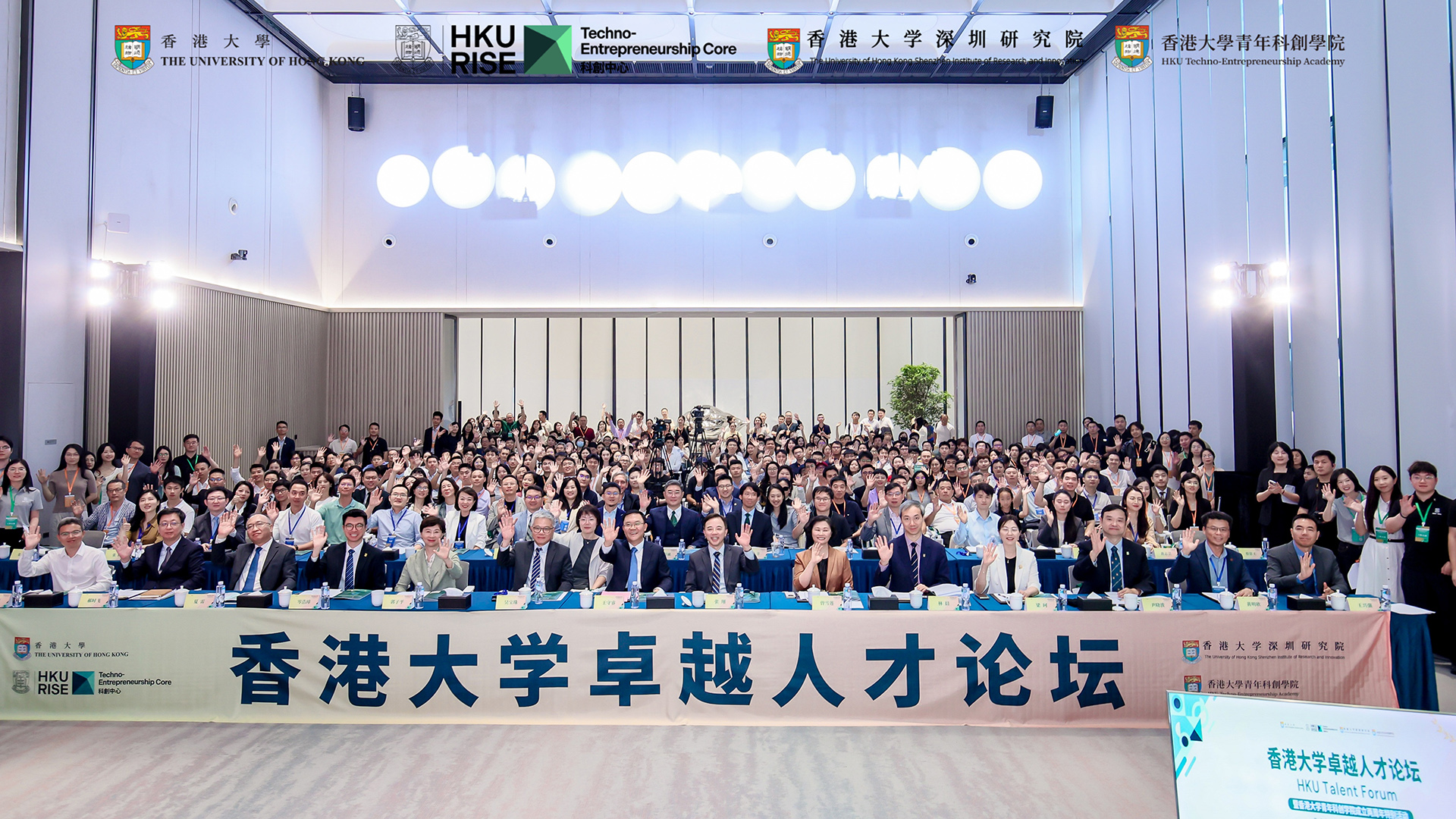
How do we define wisdom in an era of AI? Is it distinct from knowledge? These are challenging questions for universities now and go to the heart of their purpose.
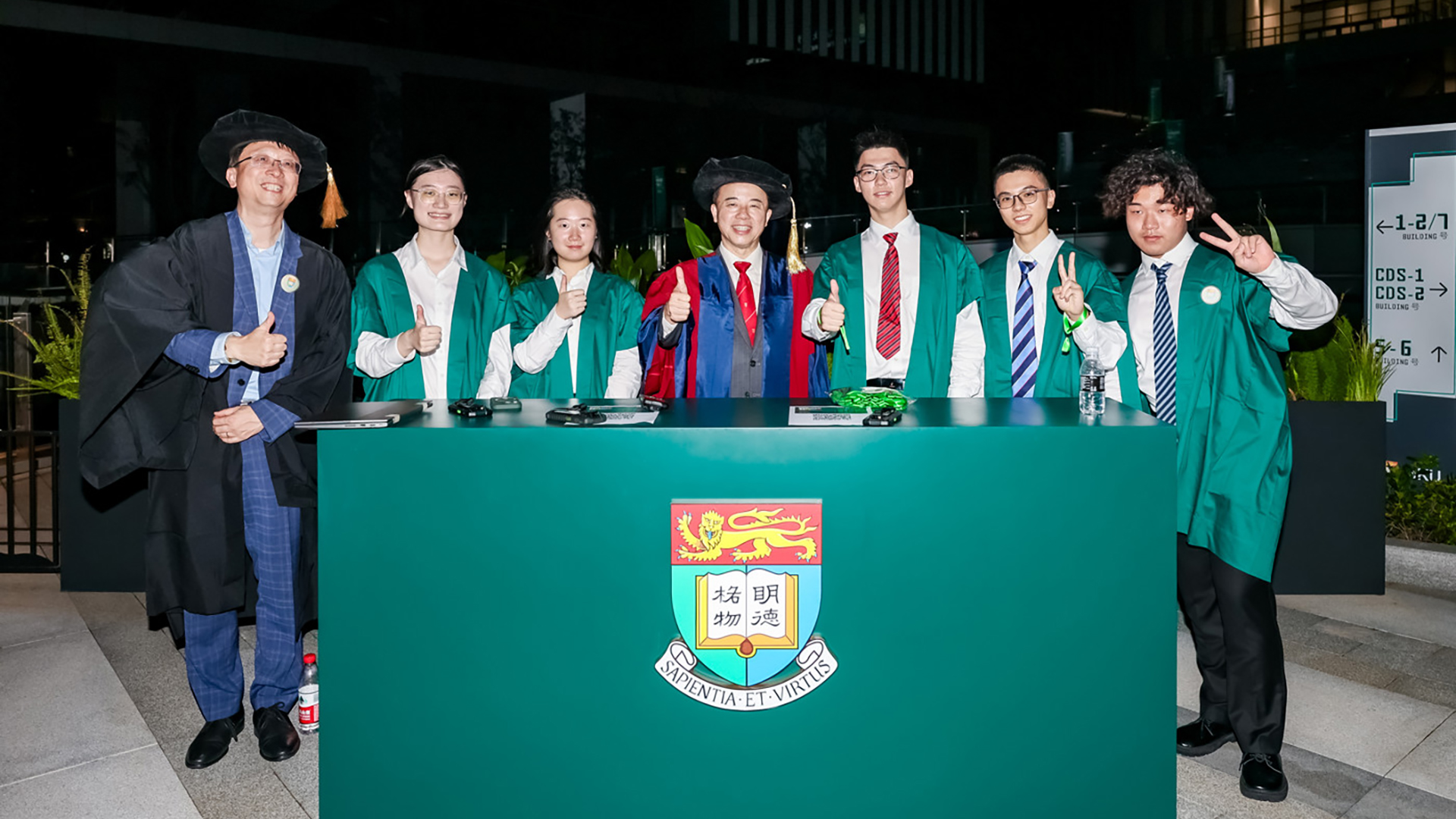
They were also the focus of the HKU Talent Forum and the Second Anniversary Celebration of the HKU Techno-Entrepreneurship Academy (TEA) in Qianhai, Shenzhen, held on September 5, bringing together government, academia, industry, investors, entrepreneurs and young innovators to discuss talent development in the age of artificial intelligence and ways to translate research into innovation through deeper Hong Kong-Shenzhen collaboration.
HKU President and Vice-Chancellor Professor Xiang Zhang set the tone for the Forum by inviting its participants to consider that future universities should not be merely repositories of knowledge. “They must be crucibles for capability-building and character formation. In an age when AI can provide answers, knowing how to ask the right questions is a higher-order form of wisdom,” he said.
Professor Zhang said HKU would continue to connect research-led education with interdisciplinary learning, project-based work, entrepreneurship and industry engagement, and welcomed long-term collaboration with employers on student development and innovation.
Joining Professor Zhang and other key HKU leaders and academics at the Forum were Mr Shourui Wang, Member of the Standing Committee of the Communist Party of China (CPC) Shenzhen Municipal Committee and Secretary of the Qianhai Cooperation Zone Work Committee of the CPC Shenzhen Municipal Committee, along with representatives from relevant Shenzhen and Qianhai authorities, and executives and innovation leaders from major enterprises and start-ups.
Mr Wang pointed out that aligning education, technology, and talent was what was driving Qianhai’s efforts to execute its landmark reform plan and help turn the Greater Bay Area into an international technology innovation centre. Staying focussed on its mission to steer by ‘relying on Hong Kong, serving the Chinese Mainland, and opening up to the world’, Qianhai was advancing an upgraded ‘1510’ development model. Building on the progress of the Qianhai Shenzhen-Hong Kong Youth Innovation and Entrepreneur Hub, this model was bringing together policies, industry-academia research, financing, talent, and key platforms into a unified support ecosystem.
The event was also an opportunity to recognise the achievements of the HKU TEA which has welcomed 100 incubated projects in Qianhai. Established in Qianhai in 2024, the Academy supports the translation of HKU research into entrepreneurship and industry engagement, while developing a cross-border innovation and talent ecosystem. During its first two years, the HKU TEA introduced 24 professors, 52 doctoral researchers, 171 young people from Hong Kong and 400 young entrepreneurs. Its projects have disclosed aggregate financing of RMB 850 million and an overall valuation approaching RMB 7 billion. To mark its second anniversary, the Bay·HUNDRED initiative was launched to further connect research, talent, entrepreneurship and industry.
Professor Ngô Bảo Châu, Fields Medallist and Chair Professor of Mathematics, explored this question of how best to nurture talent in another way. In his masterclass ‘Can Mathematical Research Help Us Survive the AI Wave?’, he reiterated the call for exercising judgement when leveraging the advantages of AI. “With AI assistance, mathematicians can understand the world better than when working independently. The economic challenge AI presents is how to redefine human value and recognise the fruits of human labour, rather than simply handing everything to machines,” Professor Ngô said. “The crucial choice is personal. We can surrender our intellect to AI, wait to be fed all responses from AI, or we can ask AI to help us achieve a broader and deeper understanding of the world.” That distinction will shape how people educate students, organise work and decide what remains worth doing for themselves.
He reminded the participants that the deepest risk lies not only in what technology like AI can do, but in the economic logic through which it is deployed. “The question is not whether we should stop technological progress. We cannot and should not. The question is what we will value when technology makes substitution possible,” he said.
“The right response is not to stand apart from AI. Let AI be our tool, our companion in that endeavour, because that’s our chance to survive this revolution,” he noted. “The word ‘companion’ matters. A companion does not absolve us of responsibility or live our intellectual lives for us. It travels with us as we undertake a difficult journey.”
The Forum, part of the HKU Talent Forum Series – HKU’s flagship Chinese Mainland platform for bringing the University’s academic and student talent into dialogue with employers, alumni, government and other strategic partners, also included other exchanges on the qualities needed for world-class talent in the AI era and on how technology ventures can progress from early-stage validation to scalable growth. Professor Chen Lin, HKU Vice-President and Pro-Vice-Chancellor (Business), observed that HKU TEA’s progress demonstrated the value of combining forward-looking policy support with an open industrial ecosystem.