At the onset of a stroke, getting treatment quickly is essential. When blood flow to the brain is interrupted, brain cells die at a rapid pace, and every minute counts to prevent death or permanent disability.
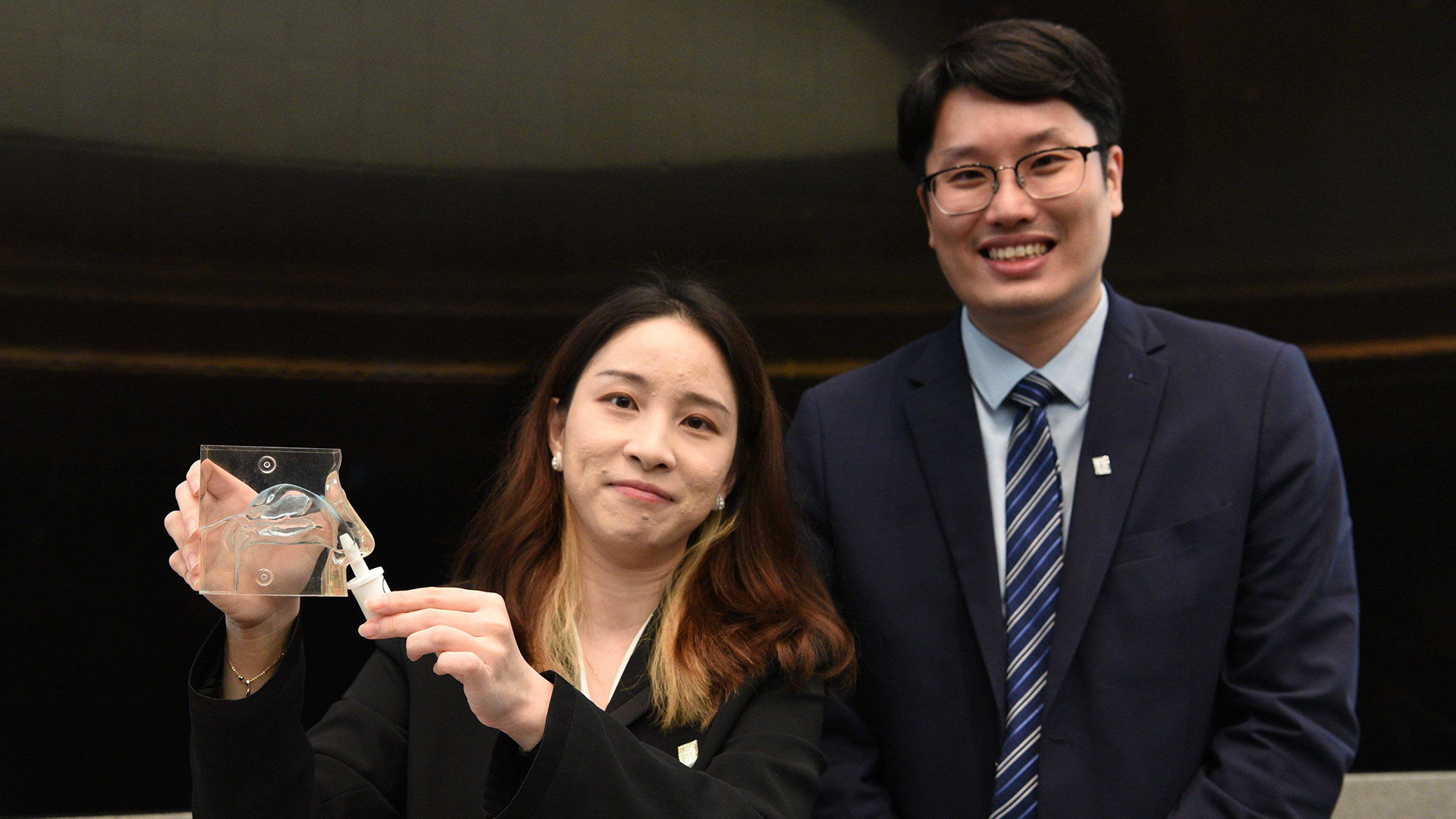
So why not try getting the medication to the brain by going up the patient’s nose? Now, an innovative ‘NanoPowder Nasal Spray’ can deliver stroke medication to the brain without the need for injections or surgery. Developed by researchers in HKUMed’s Department of Pharmacology and Pharmacy, in collaboration with the InnoHK Advanced Biomedical Instrumentation Centre (ABIC), this innovation successfully overcomes the challenge of crossing the blood-brain barrier.
Ischemic stroke has long been the second cause of death and disability worldwide, imposing an annual global burden exceeding US$890 billion on healthcare systems and societies. Current standard treatments focus on reperfusion therapies, including intravenous thrombolytics and mechanical thrombectomy.
“The nasal spray is characterised by its quick response, portability, and user-friendliness,” says Professor Aviva Chow Shing-fung, Associate Professor in the Department of Pharmacology and Pharmacy at HKUMed and Co-Principal Investigator at the ABIC.
When used promptly at the early onset of stroke, the nasal spray provides prehospital emergency treatment, helping to save time, thus protecting brain cells and reducing complications.
“It allows patients to receive early protection en route to hospital or even within the community, effectively preserving still-viable brain tissues, thereby buying valuable time for subsequent treatments.” In the long term, it has the potential to become a community-based emergency rescue tool.
The research team spent over a decade developing the ‘Nano-in-Micron’ technology platform and subsequently used it to create the ‘NanoPowder Nasal Spray’. “The failure rate of drug candidates targeting the central nervous system in clinical trials exceeds 90%, largely because these drugs cannot cross the blood-brain barrier and thus fail to reach the brain to exert their therapeutic effects,” Professor Chow notes.
To address this challenge, the research team encapsulated neuroprotective agents within nanoparticles and used particle engineering techniques to process them into inhalable micron-sized powders.
The nasal spray operates through four key steps: inhalation, deposition, de-agglomeration and delivery. The micron-sized powder is inhaled into the nasal cavity, where it effectively deposits in the target area. Upon contact with nasal mucus, the powders rapidly de-agglomerate into nanoparticles, which then travel along the nose-to-brain pathway, bypassing the blood-brain barrier to deliver the drug directly to the brain. This design significantly enhances drug delivery efficiency and onset speed, offering a breakthrough solution for prehospital emergency treatment of ischemic stroke.
Preclinical animal studies have demonstrated that administering the nasal spray within 30 minutes of stroke onset can reduce ischemic infarction by more than 80%, while effectively protecting neurological and motor functions. The study suggests that the medication may mitigate brain inflammation, prevent cell apoptosis, and preserve the integrity of the blood-brain barrier, thereby providing comprehensive protection for brain tissues and potentially extending the time available for treatment.
Dr Zitong Shao, Postdoctoral Fellow at the ABIC, emphasised that this approach is not intended to replace existing hospital treatments but to serve as an urgent, prehospital support measure. Its goal is to work in tandem with current medical systems by providing early intervention to reduce the extent of brain damage and lower the risk of death and severe disability.
“After a stroke, every second matters. Even an additional ten minutes of brain protection might determine whether a patient can walk or speak in the future,” says Dr Shao. “The key breakthrough of this technology lies in shifting stroke treatment from the ‘in-hospital’ setting to the ‘prehospital’ stage, enabling neuroprotection rather than merely clot dissolution or thrombectomy.”
This innovative prehospital emergency strategy is expected to substantially increase stroke survival rates and neurological recovery, representing a significant advancement in the treatment of brain diseases globally. The innovation was awarded the ‘Special Grand Prize – Prize of the Chinese Delegation’ and ‘Gold Medal with Congratulations of the Jury’ at the 51st International Exhibition of Inventions of Geneva. It was also a winning project in HKUMedXelerate 2025 – an innovation challenge for transformative healthcare technologies.
The NanoPowder Nasal Spray has demonstrated safety and efficacy through cell and animal experiments. The next steps involve advancing toxicology studies and clinical trials, with the aim of making this nasal spray accessible in pharmacies and communities as an emergency first-aid product, becoming the first line of defence for stroke patients. The research team is actively collecting feedback from emergency physicians and neurologists to ensure the invention aligns with real-world treatment protocols.
The ‘Nano-in-Micron’ technology platform can also be applied to deliver small molecule drugs, traditional Chinese medicine and biologics. Additionally, it has the potential to treat a range of neurodegenerative disorders, such as Alzheimer’s disease, motor neuron diseases, and cerebral infectious diseases such as meningitis.
The gratifying results to date of the ‘NanoPowder Nasal Spray’ reflect the University’s ongoing commitment to championing innovative research and building networks of support for groundbreaking initiatives that can be developed into transformative healthcare technologies for all.