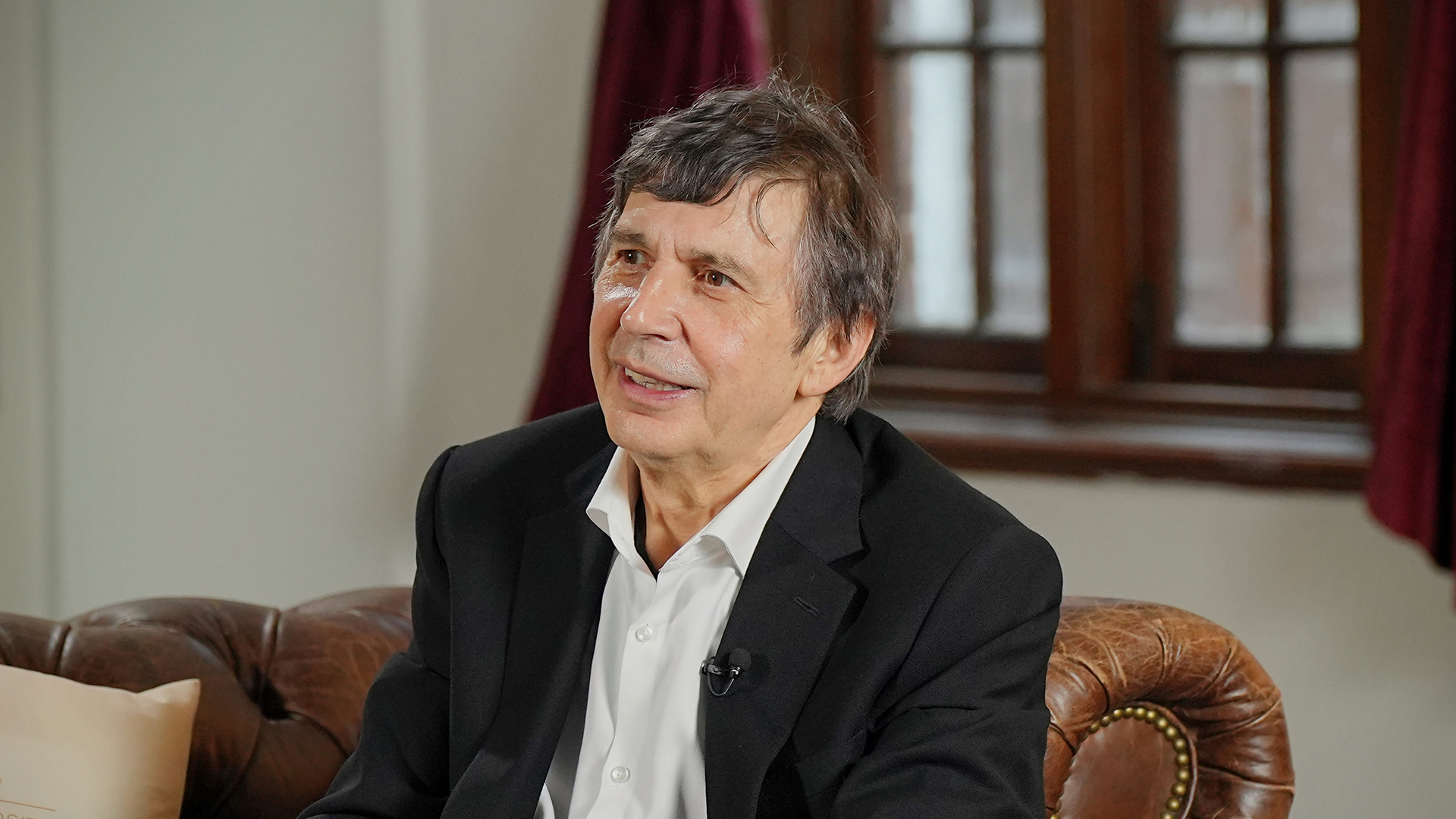
Elephants, camels, and other creatures regularly appear in the stories told by Professor Andre Geim, Nobel Laureate and Chair Professor in the HKU Department of Physics – not surprising perhaps for a scientist who famously levitated a live frog using magnets and named his tape invention after a gecko.
Join us for a walk through Professor Geim’s menagerie as he shares his insights about HKU, the current global academic research environment and his own journey into science.
Q: Do you remember when you first became interested in pursuing science as a career?
A: There was nothing very spectacular about it, actually. It was quite a standard road for me.
Genetics may have come into it, because my parents and grandparents went to university, and they were either in engineering, natural science or medicine. Not literature, not journalism, and they weren’t lawyers or politicians – so I think genetics played a big role!
As a student in school, high school, and university, I was encouraged by teachers and my parents to do my best, to work hard. They pushed me to work hard and be smart, but while I would try to be always close to the top of the pyramid, either at school or at university, I never tried to be at the very top. Or at least I never tried to be number one. What I did try to do was to get the highest marks possible with minimum effort – and I did get the highest marks possible! That was kind of my mantra, although I didn’t formulate it so clearly at that time.
But then, I got my PhD, and at that moment, I started working more independently. I discovered that I had so many peers around the world with whom I wanted to compete, and that was when I really started to seriously push myself, rather than just putting in minimum effort. That took everything I could give, because I had never been in first-tier universities, in terms of facilities, and so on, so I had to compensate by putting in the hard work, trying to be inventive, and using whatever facilities were at my disposal.
Q: As a globally renowned scientist you presumably had your pick of places to work in the world, so why did you choose to come to Hong Kong and HKU?
A: Well, it’s a little bit of an exaggeration to say that I had my pick of places!
There are a limited number of universities in the world that could have offered competitive facilities, because I’m an experimentalist and my work requires quite expensive facilities. There were some very high-quality universities in this part of the world, of course. So, I enjoyed visiting for maybe two months every year, but my base was mostly in Manchester in the UK.
I never thought of relocating until a few years ago, when some circumstances changed. In Britain, there was Brexit, there were the hectic and irrational governments of Boris Johnson or Liz Truss, there was COVID, after which everyone worked from home, and the whole atmosphere in Britain underwent a shift.
But the straw that broke my back, even though I’m not a camel, was the restriction imposed on the students I wanted to hire. I’m a quantum condensed matter physicist and my students deal with low temperature and high magnetic fields. And for some reason, the British government decided to regard these fields as being on par with weapons of mass destruction. They sent me a letter literally saying that my prospective PhD students might use the acquired knowledge in the proliferation of weapons of mass destruction. Absolute nonsense from people with no clue about fundamental research! So they essentially completely levelled out my research because I can’t work without young, highly educated people.
I was left with no choice but to look for an alternative, and HKU approached me with an offer and asked me to come here. Usually it takes many years for people to consider any international move, but in this instance, it was a case of good timing from HKU, combined with unhelpful developments in the UK government policies on science – those two were crucial deciding factors.
Q: What sort of research culture do you want to establish at HKU?
A: I don’t have a lot of experience of cultures other than my own, but I have learnt something from observing my PhD students over the years. They tend to fall into two categories: those who want to be left alone and proceed at a leisurely pace or those who push themselves harder and want to get involved in our joint projects.
The latter bring more energy to the group and can help us move quicker than other competing groups, so it’s a good kind of symbiosis.
I’m basically aiming for a research culture built on good teamwork.
Q: How did you choose your research areas?
A: If there’s a subject that many people around the world are interested in, if you want to work in that area, you really have to be in the right place at the right time.
The basic thing is that I try not to work in subjects that are overcrowded. This is what I’ve been doing over the course of my career. At the institutions I was at before, I would try to find niches where there were not so many, well, elephants trying to forage on a small piece of grass, so to speak.
And then when you eventually find a small piece of untouched grass and you start to dig deeper, you find that another herd of elephants is coming into this area, and then you have to jump into another research area.
So the circumstances of working somewhere else will force you to be more inventive. It’s both an advantage and a disadvantage of not working in the top, best equipped and best staffed universities. That’s the reality of this world.
It’s tough, because doing this kind of jumping requires a lot of learning and acquiring knowledge about areas you’ve never worked in before. However, in the end, it’s more fun and has turned out to be more productive, but it requires almost encyclopaedic knowledge to do that, to jump between different areas. But for me, going into a research area that is already overcrowded makes no sense.
And equally important is the question of what you can really contribute to that area. For example, say I’m very interested in genomics and so on, and I would love to work there. But I ask myself a question: what I can contribute to this area? Do I have any facilities, or specialised knowledge, or any novelty elements to contribute? And since the answer is no, I’m not going there!
Q: Your discovery of graphene has brought you global recognition and a Nobel Prize. Could you tell us more about its potential?
A: It’s just the tip of the iceberg, which is a very overused term, but that’s what it is. Graphene was the very first of the two-dimensional materials. A year later, we published that we could extract many materials that were one atom or one molecule thick, similar to graphene.
I actually consider this second paper more important than the paper which was acknowledged by the Nobel Foundation. It seems that even the Nobel committee couldn’t see the forest for the trees in this instance, because everyone was so excited about graphene, but they didn’t see the bigger picture.
So, in this case, graphene was a new class of materials science, a new class of materials. Twenty years ago, we even didn’t suspect that those materials existed in our world, and most people believed that those materials couldn’t possibly exist – and yet here we are.
And after that came what I sometimes call graphene 3.0, it’s like designer materials assembled from different atomic planes, like a Lego game, played with individual atomic layers. We just don’t have enough scientists around the world to investigate this cornucopia in detail, even leaving aside industry.
The way I try to describe it for people is that for industry, it’s a very first step, not even a baby step! It’s like a baby monkey step, because people don’t even use the existing knowledge we have in academia. They hear about the material and they try to put it in their recipes without thinking what could happen. It’s a trial-and-error approach, and it’s only about graphene, forget about other atomically-thin materials. Presently, there is no complex, high-tech technology based on graphene; all graphene technology is cookery at the moment.
Nonetheless, it has already been embedded in quite spectacular achievements, as improvements of modern electric vehicles and batteries, and all kinds of gadgets, and electronics, and so on, but it’s still cookery, rather than science, or knowledge-led application of what we know about these two-dimensional materials.
It takes time for knowledge to seep through so many layers of people, from applied researchers to engineers to industry. It’s like water seeping through volcanic rocks. Nothing can be done about this except for, of course, trying to stimulate young people to take some ideas and move them from academia directly to start-ups and spin-off companies.
Q: What about the gecko tape?
A: Oh, that’s an older area. There are a thousand papers published about this subject, or that at least cited our first paper.
But it’s a tricky subject. I have seen a person hanging from a ceiling using this gecko tape, so it works. The trouble is that you can reproduce the tape, but it can get soiled quickly. Its artificial hairs become attached to each other and to the surface.
So as far as I know, no one studied how geckos cleaned their feet! It’s a question for biologists to address, because you know, if your hands are wet, everything you touch will be covered with dust. In the microelectronics industry, you have these clean rooms, because if you have dust in the air and particles drop on the surface, they are stuck forever.
So the question is how do geckos keep their toes and feet sticky, and not covered with dust? How do they clean them? I have no clue about this one!
If we can reproduce that feat, then we will have gecko gloves. Without that, we don’t have the fundamental knowledge yet to make this tape re-stickable. You can make the tape now, no problem about that. But it would be, in a sense, a one-time-use gecko tape.
Q: So at HKU, you’ll be mainly working on two-dimensional materials?
A: Yes, the focus now will be on two-dimensional materials, or more generally, assemblies of those materials, we call them nanomaterials. It’s something which can be used for technologies where quantum mechanics plays a critical role.
It will help the next quantum revolution, where quantum physics will be used, not superficially, as it is used now, but on a deeper level, including quantum coherence, interference, and coupling of different states, and superposition of different states – a deeper level of usage of quantum mechanics.
Q: How will that change? Can you give an example of the difference it’s going to make?
A: It’s basically the same way that transistors were different from vacuum electronics.
You will probably still remember those TVs and radios, which contained electronic vacuum bulbs, which work essentially as transistors. Those were about the size of a fist in diameter sometimes.
Now, thousands of them can be on the cross section of your hair, and this is essentially quantum mechanics. It’s taking things to a different level, like the change from incandescent lights to LED lights. The former uses simple heating, while LED involves quantum mechanics.
So we just want to take the next step in using quantum physics and make those elements smaller and smarter, and more functional, and more intelligent. All this at once.
And this is a natural road. There is, of course, a bit of wishful thinking about how big this can become, but it’s still a natural road to follow. We know it’s inevitable, we need to go there.
Q: What is the next type of research focus that you would like to establish at HKU?
A: We’re discussing the creation of an institute for quantum nanotechnology. It’s about leading the second quantum revolution. Quantum physics is an obscure term for many people, but without it, your mobile phone wouldn’t work, your camera wouldn’t work, your TV wouldn’t work – these all involve quantum elements, one way or another. The telecommunications in our modern world just won’t run without it. That’s done and dusted.
But there is another revolution coming, which some people refer to as quantum information, quantum communication, and so on, which takes into account more subtle elements. AI is also a part of this.
What we are aiming for are infrastructure and facilities for HKU – and that other local universities might have access to too as partners – which would search for the materials and devices on which this second quantum revolution could be built.
We hope that the institute will be up and running within two or three years, but it’s fundamental research, so you won’t find it transformed into gadgets in your home within the next 10 to 20 years. But in terms of high-quality publications, visibility for HKU, and in terms of new talent who are coming to join the University, and who will graduate from here – you should see all this happening within five years.
Q: Finally, what do you do to unwind?
A: Mountains, my hobby is mountains. I mean, serious mountains, where people get mountain sickness, something above 4,000 metres! I still go to those, I like it up there.
I love hiking, so Hong Kong is a big attraction for me in that way, with the possibilities of great hikes here. Probably about 10 years ago, I did a hike on Lantau Island, when I was staying at a Hong Kong airport hotel, and I went for a hike.
And in two months of arriving here, I have already done a dozen trails here in Hong Kong, which are so nice, and it’s great for hikers like me. I even know about the famous Four Trails: MacLehose Trail, Wilson Trail, Hong Kong Trail and Lantau Trail! I have done parts of those already.
I know that most people around the world look at Hong Kong and may think that it’s all just like the Central district. They don’t know how green it is, even on Hong Kong Island, not to mention the New Territories, Sai Kung, or Lantau Island.
This is really, for me, a very attractive part of living in Hong Kong. Having this possibility of going for a good hike, for five or six hours, then coming back down and ending up somewhere on a beach, and having a swim in pristine water – it really is a kind of paradise!