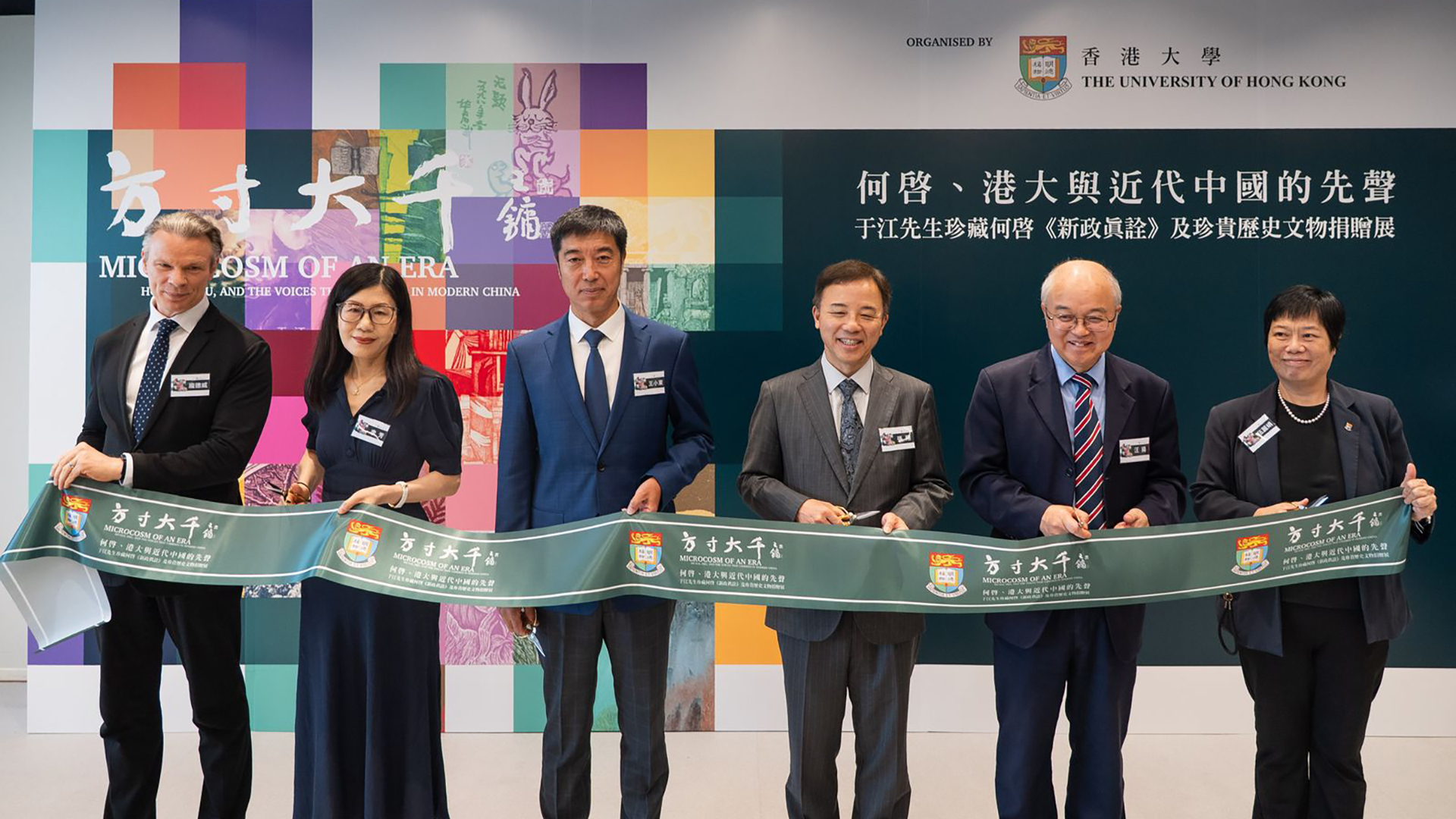
A new exhibition titled Microcosm of an Era: Ho Kai, HKU, and the Voices that Ushered in Modern China is now open at HKU. Curated from the private collection of Mr Yu Jiang, this generous donation of rare books and historical artefacts is far more than a display of antiquities. It is an invitation to travel back in time – to an era of profound upheaval where East met West, and the old world violently gave way to the new.
At the centre of this historical tempest stood a complex and deeply compelling figure: Sir Kai Ho Kai. He was neither a pure colonial elite nor a professional revolutionary. Yet, as the core founder of the Hong Kong College of Medicine for Chinese – the predecessor of HKU – he became the most crucial, and perhaps most hidden, driving force behind the early days of Sun Yat-sen’s revolution. To understand Ho is to understand HKU’s unique and irreplaceable position in the progression of modern Chinese history.
A Dual Identity in a Colonial Port
Wandering by the remaining pre-war, low-rise buildings around Staunton Street in Central today, it’s hard to imagine the world of secret passwords and revolutionaries of over a century ago. But if you head a bit further west to HKU’s main campus, you’ll find a bronze statue of Sun Yat-sen, staring intently into the distance and standing as a permanent reminder: this was a place for those whose mission was to change China.
In the annals of HKU’s history, Ho’s name is often referred to ‘founding father’ or ‘founder of the College of Medicine’. But his true impact was far greater. Born at the dawn of colonial Hong Kong in 1859, he was the son of the Reverend Hoh Fuk-tong, a prominent Chinese pastor who served as one of the earliest cultural bridges between the Chinese and Western worlds. This lineage placed Ho at the intersection of Eastern and Western civilisations from a young age. He attended the Government Central School (the predecessor of Queen’s College), graduating in 1872 before travelling to Britain to pursue his studies. There, he earned a Bachelor of Medicine and Master of Surgery from the University of Aberdeen, and subsequently qualified as a barrister at Lincoln’s Inn. He returned as a trailblazer – one of the first Chinese to practise both Western medicine and law in Hong Kong.
But Ho was never merely a ‘Westernised elite’. In 1887, to honour his late English wife, Alice Walkden, he funded the establishment of the Alice Memorial Hospital. In the same year, he was instrumental in founding the Hong Kong College of Medicine for Chinese – the institution that would evolve into HKU’s Faculty of Medicine, and one of the earliest institutions established specifically to provide Chinese students with a systematic Western medical education. Yet his vision extended far beyond training skilled physicians. Ho turned the college into an intellectual enclave. He wanted his students to use the understanding of medicine as a means to grasp the essence of Western political systems and the rule of law. This educational philosophy effectively transformed the medical college into a frontline outpost for late Qing intellectuals to encounter modern political thought.
Ho’s enduring legacy at HKU also stems from the deep sense of national concern he injected into its DNA. Appointed as an unofficial member of the Legislative Council in 1890 – a position he held for 24 years – he served as the most vital conduit between the British colonial government and the local Chinese community. Yet his establishment status never diluted his anxiety over the fate of his motherland.
Xin Zheng Zhen Quan: A Treasure Trove of Ideas
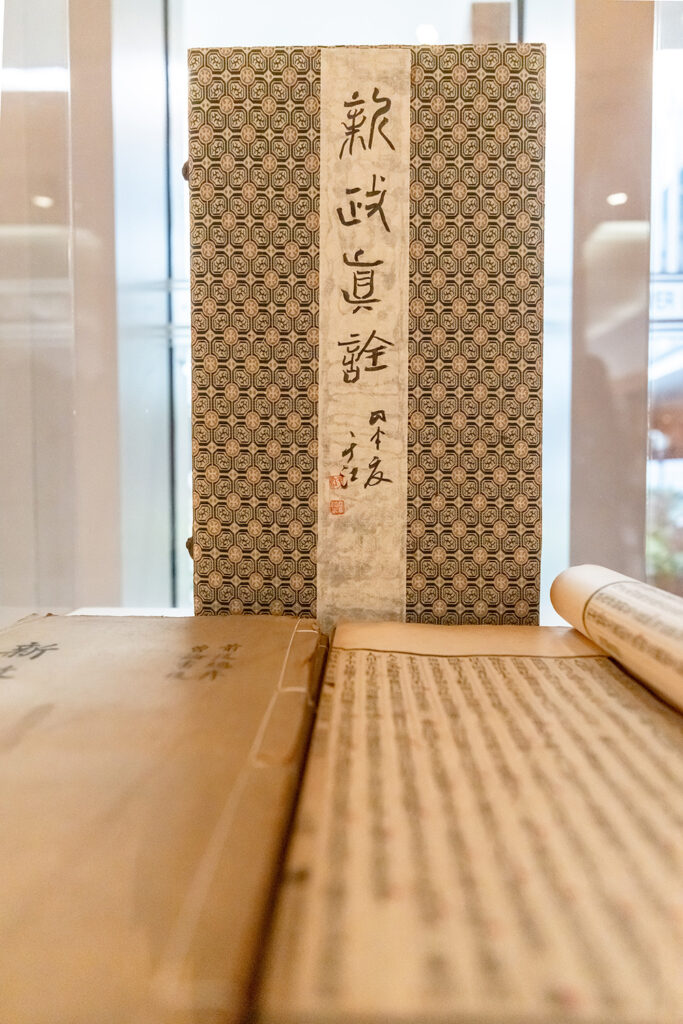
This anxiety is powerfully illustrated in Xin Zheng Zhen Quan (The True Interpretation of New Policies), a seminal book co-authored by Ho and his close friend Woo Lai-woon, which features prominently in the exhibition. The work systematically advocated for a constitutional monarchy and vehemently rejected the prevailing Qing dynasty doctrine of ‘Chinese learning for the fundamental principles, Western learning for practical application’. Ho argued that China’s shortcomings lay not in its lack of modern machinery, but in its very institutions. True self-strengthening, he insisted, required commerce and civil rights, not just the importation of military technology.
The book became a treasure trove of ideas for both reformists and revolutionaries in the late Qing era. What Ho represented was the most significant aspect of HKU’s early spirit: one who lived on a colonial island, yet who was at heart tethered to the rise and fall of the Chinese nation; absorbing the best of Western learning, but with the ultimate goal of reforming China. For this exhibition, Mr Yu has gone further still, donating to HKU the complete first edition of Ho Kai’s Xin Zheng Zhen Quan, ensuring that these documents of intellectual revolution find their most fitting home in the university Ho himself helped establish.
The Making of the HKU Spirit
The significance of Xin Zheng Zhen Quan extended beyond its role as an intellectual blueprint for late-Qing political reform; it profoundly influenced Ho’s educational philosophy, which ultimately shaped the essence of the Hong Kong College of Medicine for Chinese, the predecessor of the University of Hong Kong. Ho repeatedly asserted that China’s weaknesses stemmed from three fundamental deficiencies: the ignorance of its people, the inadequacy of its legal system, and the absence of civil rights. He believed that reforming China required that these issues first be addressed and that this could be achieved by embracing the spirit of Western learning. This conviction was vividly reflected in his meticulous design of the College’s curriculum, where he not only taught anatomy and surgery but also introduced Western constitutional history, ethics, and political philosophy. His vision extended beyond training physicians; he aimed to cultivate the younger generation, endowing them with a modern civic consciousness and a sense of national responsibility.
In other words, Xin Zheng Zhen Quan laid the foundation for shaping the HKU spirit. The ideals Ho articulated in its pages became the guiding principles he spent a lifetime working to turn into educational reality at the University. Historical records suggest that during the planning of HKU, Ho insisted on the inclusion of a faculty of arts, making HKU a rare institution at the time that placed equal emphasis on Chinese and Western learning. The intention was profound: Ho did not want HKU students to become Westernised elites with ‘yellow skin and white hearts’. He wanted them to use Western learning as a mirror to re-examine and ultimately transform China.
The Teacher and the Revolutionary
If Ho was the one who struck the match of HKU’s intellectual spirit, Sun Yat-sen was the blazing light that ultimately illuminated modern China. In 1887, a 21-year-old Sun transferred from the Canton Hospital Medical School (Pok Tsai Medical School) in Guangzhou to the newly established Hong Kong College of Medicine for Chinese, becoming part of its inaugural class. Sun and his classmates – Chen Shaobai, Yeung Hok-ling, and Yau Lit – frequently gathered to discuss politics and advocate for the overthrow of the Qing dynasty, earning themselves the nickname the ‘Four Bandits’.
According to HKU historian Professor John Carroll, the political ideology of the Father of the Nation “stemmed at least in part from his early familiarity with Ho Kai’s theories of popular sovereignty.”
Sun later reportedly confirmed to Ho’s son-in-law, Foo Ping-sheung, that he “benefited greatly from Ho Kai’s teachings.” What Ho imparted to Sun was far more than medical knowledge; it was a paradigm that bridged the art of healing the human body with the art of healing a nation.
Ho’s political tutelage planted the first seeds of reform in Sun’s mind. But the student would go much further than the teacher. When the illusion of peaceful reform was shattered by the gunfire of the First Sino-Japanese War, Sun resolutely turned to armed revolution. Ho, on the other hand, maintained a stance of gradual reform throughout his life, even as he sympathised with and covertly aided the revolutionary cause. This divergence was not a rupture, but rather two different manifestations of the same intellectual roots across different generations.
More intriguingly, Ho played a critical role as a ‘behind-the-scenes’ facilitator during the early stages of Sun’s revolutionary career. Although he never officially joined the Revive China Society (Xingzhonghui), he deeply approved of its aims and frequently participated in its planning. He helped fund the society’s newspaper, China Daily. During the planning of the 1895 Guangzhou Uprising, Ho used his status and English proficiency to manage external propaganda and introduced crucial financial backers. During the preparations for the 1900 Huizhou Uprising, he attempted to leverage his connections with Hong Kong’s English-language press to secure British support for Sun, ensuring the colonial government maintained friendly neutrality.
Professor Carroll’s research notes that Hong Kong Governor Francis May, in a report to the Colonial Office, accused Ho of having family ties with Sun’s friend Chen Shaobai – who later served as Director of Foreign Affairs of the Guangdong Military Government – and suspected Ho of drafting a ‘detailed constitution’ for the newly formed Guangzhou government. This suspicion ultimately cost Ho the trust of the colonial government and ended his political career in the Legislative Council.
It is fair to say that Ho provided Sun’s revolution with more than just intellectual enlightenment – he offered crucial early funding, networks, and a shield of public opinion.
Sun ‘Returning Home’
February 20, 1923, is a date that will stand out like a beacon in the annals of modern Chinese history. On this day, Sun Yat-sen returned to his alma mater. In the Great Hall, now Loke Yew Hall, of the Main Building, he addressed an audience of students and faculty in English.
He began with a powerful declaration: “I feel as though I have returned home, because Hong Kong and the University of Hong Kong are the birthplace of my knowledge.” He then delivered the famous assertion that echoes to this day: “Where and how did I get my revolutionary and modern ideas? I got my ideas in this very place; in the Colony of Hong Kong.”
Sun then recounted how, 30 years earlier, while studying in the city, he would wander the streets and observe its orderly society, magnificent architecture, and its diligent officials who served with integrity. Yet, just a short distance away in his native Xiangshan, he saw corrupt bureaucrats and ruined roads. How could two places, barely 50 miles apart, be so vastly different? This stark contrast, he explained, drove him from the study of municipal administration to the study of politics. He concluded that the ‘bad government’ had to be completely overthrown, and the decaying imperial system replaced by a benevolent republic.
Sun’s speech was not merely a retrospective of his own intellectual journey; it profoundly revealed the invisible but visceral bond between HKU and the modern Chinese revolution. It was the progressive Western curriculum, the fiercely free academic atmosphere, and the presence of educators like Ho Kai – men possessing both a ‘Chinese heart’ and a ‘global vision’ – that allowed Chinese students to observe the logic of modern statecraft up close, thereby igniting a critical consciousness against traditional Chinese politics.
Sun was not an isolated case. Many early HKU alumni went on to join the National Revolution, the War of Resistance against Japan, and the rule of law construction of the new China. What they all had in common was this unique perspective of ‘looking at China from Hong Kong’: possessing both a firsthand understanding of Western systems and a visceral apprehension about the fate of their homeland. The formation of this perspective was inextricably linked to the ‘Chinese concern’ deliberately preserved in the curriculum by founding figures like Ho.
So, when Sun Yat-sen declared in Loke Yew Hall that his revolutionary ideas came from Hong Kong, he was effectively placing HKU at the very centre of China’s modern transformation. Ho’s reformism and Sun’s revolutionary practice engaged in a dialogue across time and space within its walls. The difference between colonial rule of law and the reality of China’s corruption formed a piercing contrast here. And generation after generation of youth who emerged from the campus on Pok Fu Lam Road carried these seeds of thought back to the mainland, where they took root in vaster soil. The profound historical connection between HKU and modern China is not a retroactive embellishment by later generations. It was personally confirmed by Sun Yat-sen, proven by the lifelong endeavours of Sir Kai Ho Kai, and forever etched into history by that speech in Loke Yew Hall that drew thunderous applause.
Today, as people stroll through the HKU campus and gaze up at the bronze statue of Sun Yat-sen by the Lily Pond, they might suddenly realise: the gravitas of this University lies not just in its academic heritage, but in the fact that it once stood at the very centre of the most painful, yet most powerful, intellectual storm in modern China – serving as a silent, but unyielding, beacon of light.
- 22 July – 5 August 2026
- G/F Lobby, Run Run Shaw Tower, Centennial Campus, HKU
- Free admission. All are welcome.