HKU and the South China University of Technology (SCUT) will work together to build a key international cooperation hub for subtropical architecture and urban science research. The partnership aims to support the Greater Bay Area’s transformation into a world-class bay area and a globally competitive urban cluster.
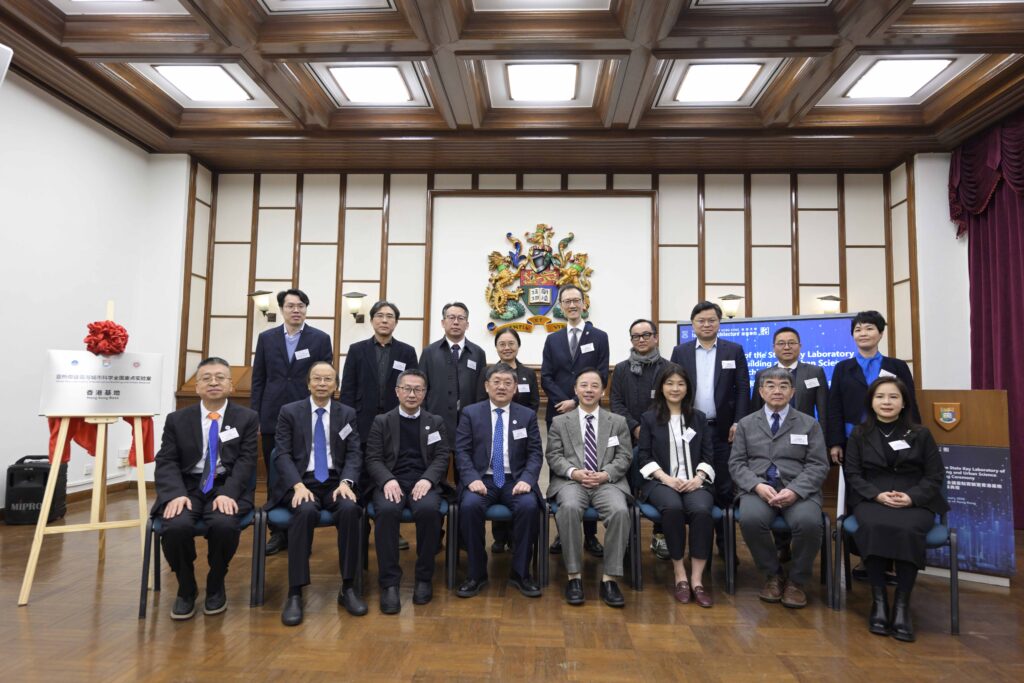
At a launch ceremony this month, the two universities formalised this partnership for a Strategic Collaboration Agreement to establish the Hong Kong Base of the State Key Laboratory of Subtropical Building and Urban Science (SKL-SBUS).
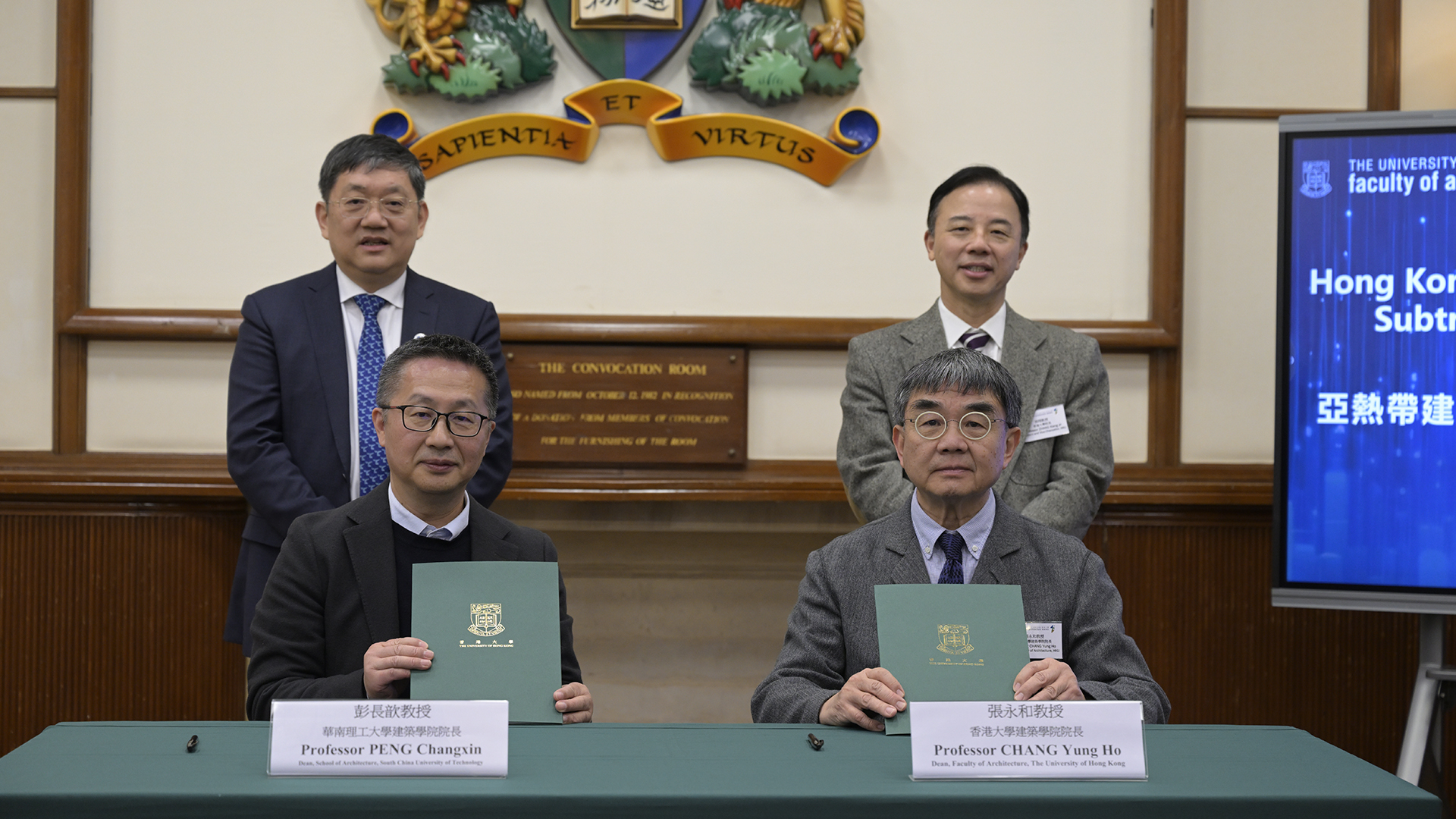
The ceremony and plaque unveiling were officiated by Professor Hongwu Tang, Academician of the Chinese Academy of Engineering, President and Deputy Secretary of the Communist Party of China Committee, SCUT; and Professor Xiang Zhang, President and Vice-Chancellor, HKU. The Strategic Collaboration Agreement was signed by Professor Changxin Peng, Dean of the School of Architecture, SCUT, and Professor Yung Ho Chang, Dean of the Faculty of Architecture, HKU.
In his opening address, Professor Xiang Zhang said he was honoured to have the Hong Kong Base of SKL-SBUS established at HKU. “Our Faculty of Architecture, Urban Systems Institute, and Department of Urban Planning and Design possess strong research capabilities and achievements in areas such as subtropical architecture, sustainable urban development and smart cities, which align closely with the collaborative direction of this Agreement,” he noted. “HKU’s research strength in relevant fields, experience in international collaboration, and talent cultivation system will provide strong momentum for the development of the Hong Kong Base.”
Established by SCUT, SKL-SBUS focusses on major scientific and technological challenges in subtropical architecture and urban systems, particularly in smart transformation, carbon reduction, and resilience enhancement. Its key objectives include coordinated regional development and climate adaptation, green building design and cultural preservation, low-carbon construction and structural resilience improvement, alongside intelligent sensing and data-driven solutions. SKL-SBUS makes significant contributions to high-quality construction and sustainable development in the Greater Bay Area.
The newly established Hong Kong Base is a comprehensive platform integrating scientific research, talent cultivation, and social service. The Hong Kong Base is committed to cutting-edge research in areas such as innovative design for high‑density urban architecture in subtropical regions, urban ecological resilience and coordinated development, and smart cities and urban renewal models. Furthermore, the Hong Kong Base will provide robust technical support and professional consultation for key areas such as urban development, rural revitalisation, ecological protection, sustainable development, urban renewal, and smart transformation in both Hong Kong and the GBA.