For anyone who adores diamonds and believes they can never have too many, good news: in the future, our lives will be filled with them – they’ll be everywhere! Perhaps not exactly the type of diamonds that Marilyn Monroe described as being her best friends, but rather – ultra-thin, flexible diamond membranes that share the same provenance.
Diamonds, renowned globally as valuable gemstones, have exceptionally versatile scientific and engineering applications. They are the hardest natural material, boasting unparalleled thermal conductivity at room temperature, extremely high carrier mobility, dielectric breakdown strength, an ultrawide bandgap, and optical transparency spanning from the infrared to the deep-ultraviolet spectrum. These remarkable properties make diamonds ideal for fabricating advanced high-power, high-frequency electronic devices, photonic devices, and heat spreaders to cool high-power density electronic components, such as those in processors, semiconductor lasers, and electric vehicles.
However, the inert nature and rigid crystal structure of diamonds pose significant challenges in fabrication and mass production, particularly for ultra-thin and freestanding diamond membranes, thereby restricting their widespread usage.
This is where a research team from HKU’s Faculty of Engineering stepped in with a groundbreaking innovation to revolutionise diamond fabrication for producing ultra-thin and ultra-flexible diamond membranes on a massive scale.
The research project ‘Scalable fabrication of flexible, ultra-flat diamond films’ was co-led by Professor Zhiqin Chu in the Department of Electrical and Computer Engineering and Professor Yuan Lin in the Department of Mechanical Engineering at HKU, and conducted in collaboration with Professor Li Kwai-hei from the Southern University of Science and Technology, and Professor Qi Wang of the Dongguan Institute of Opto-Electronics of Peking University.
The team developed an innovative ‘edge-exposed exfoliation’ method that enables the rapid production of scalable, freestanding diamond membranes. Unlike conventional approaches, which are often time-consuming, costly, and limited in size, this novel technique can fabricate a two-inch diamond wafer in just 10 seconds, offering exceptional efficiency and scalability.
The implications of this research extend beyond the academic realm into significant social impact. The resulting ultra-flat and flexible diamond films are crucial for high-precision micro-manufacturing and open new possibilities for next-generation flexible and wearable electronic and photonic devices. The research team envisions significant industrial applications spanning electronics, photonics, mechanics, thermal management, acoustics, and quantum technologies.
For instance, these diamond membranes could be used in advanced medical devices that require high precision and flexibility, potentially improving patient outcomes. Additionally, their thermal properties could enhance the efficiency of devices used in electric vehicles and renewable energy systems.
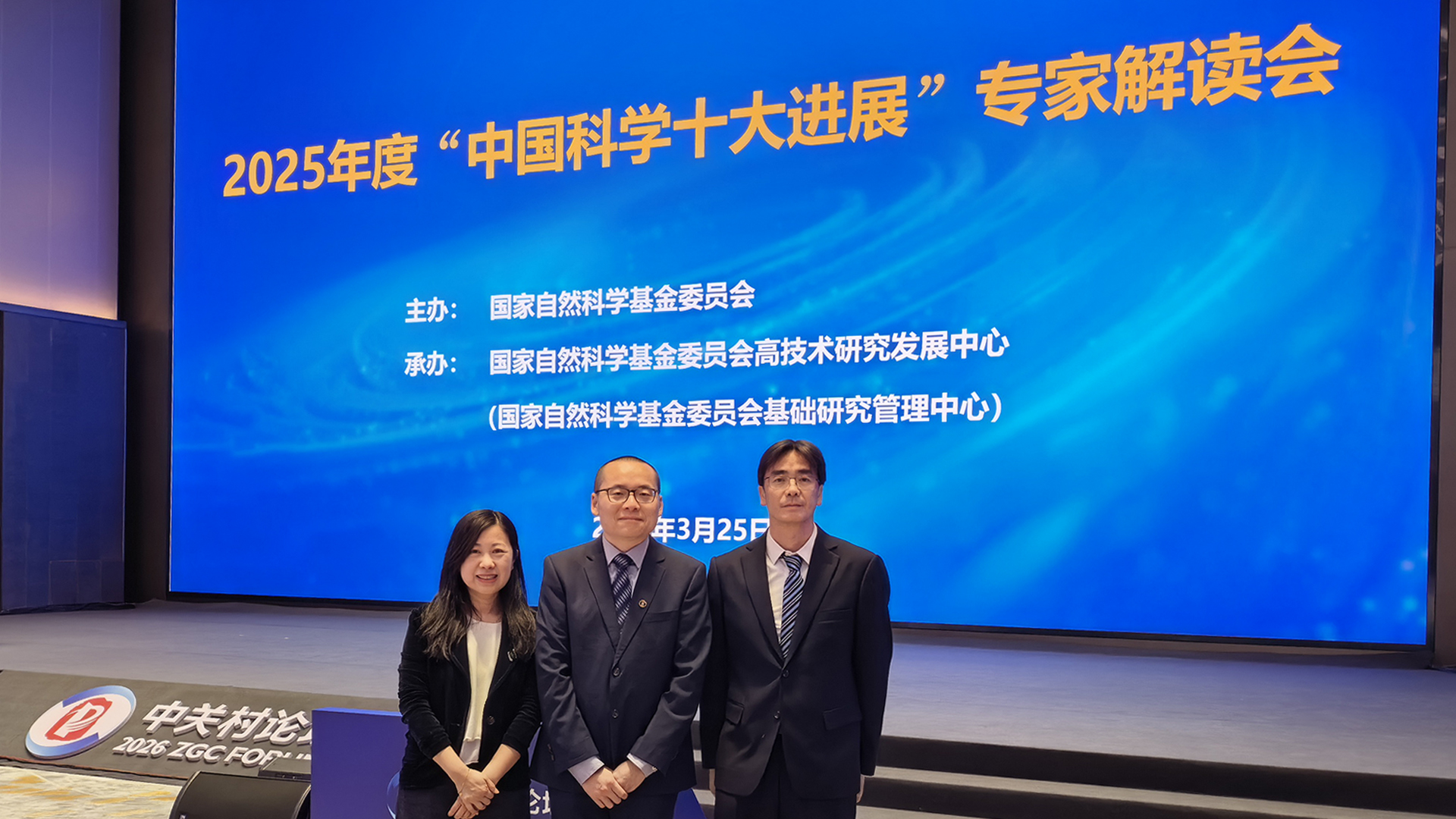
The ‘Scalable fabrication of flexible, ultra-flat diamond films’ project was recently selected as one of China’s Top 10 Scientific Advances of 2025.
The annual ‘Top 10 Scientific Advances’ selection is organised by the National Natural Science Foundation of China to highlight outstanding achievements in basic research, motivate researchers to continue advancing original research and enhance public engagement with science. Since 2005, this annual selection has become a key benchmark for national basic research.
“I feel deeply proud to have had the opportunity to collaborate with a national major scientific device team to achieve this recognition,” noted Professor Chu. “I am also very pleased to see that a scientific breakthrough from Hong Kong can contribute to the broader national technological development, demonstrating the significant potential of local innovation. I firmly believe diamond materials can move beyond traditional applications, such as jewellery or tools, and advance into higher-end fields like semiconductors and quantum technology, thereby enhancing our everyday lives and the way we live.”
Professor Lin added, “It is highly gratifying that the fundamental research we are conducting at HKU is providing solutions to major industry bottlenecks. This honour will encourage us to continue pursuing excellence and strive to make even greater contributions to national technological development.”
These diamond technology breakthroughs highlight the transformative potential of diamonds in science and engineering. As these technologies continue to develop, they promise to set new standards in fields ranging from biomedical engineering to advanced electronics, and may well usher in an era in which diamonds are indeed everyone’s best friend.