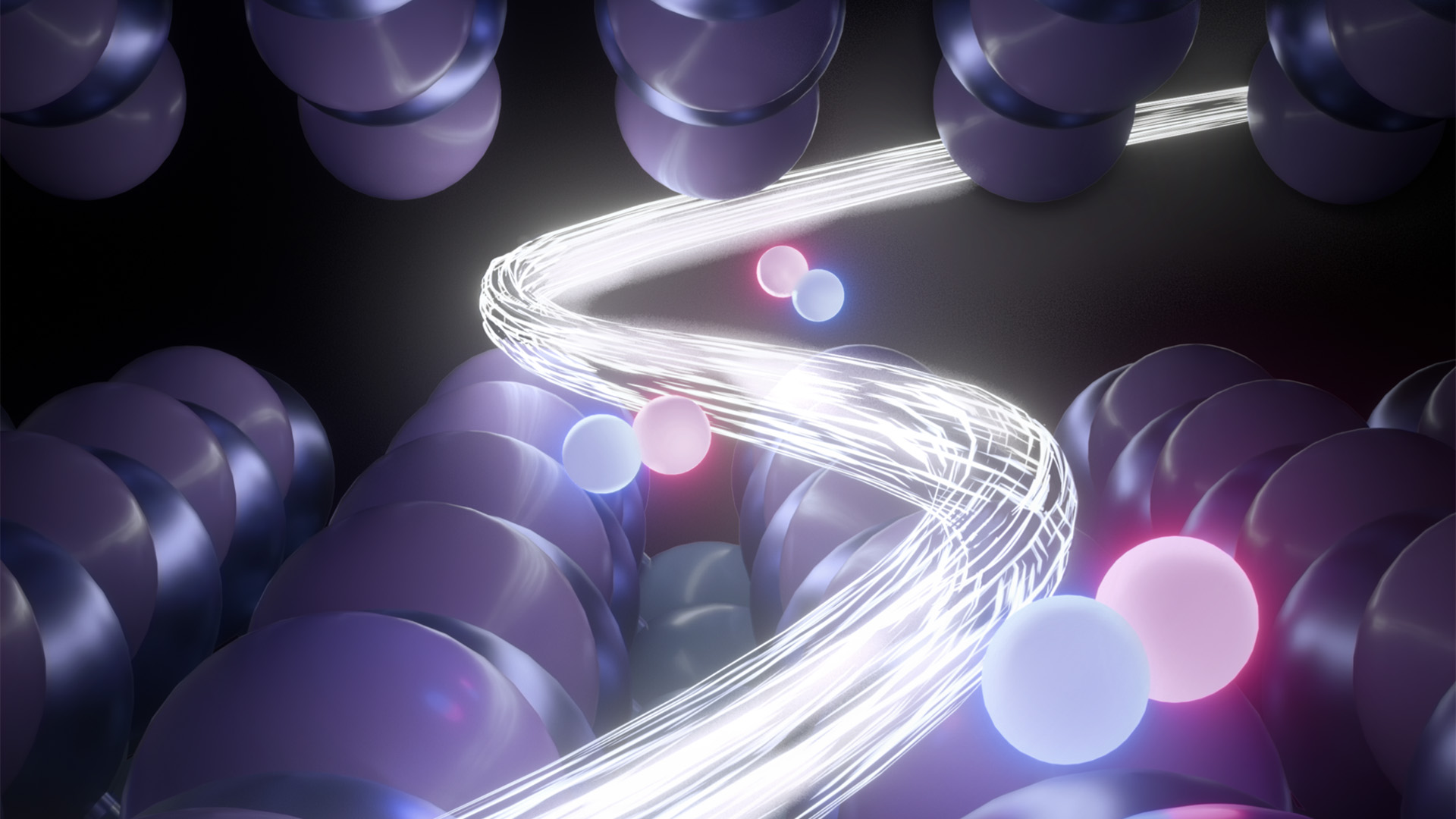
Imagine shining a flashlight into a material and watching the light bend backward, or in an entirely unexpected direction, as if defying the law of physics. This phenomenon, known as negative refraction, could transform imaging, telecommunications, and countless other technologies.
Now, a team of scientists led by Professor Xiang Zhang, HKU President and Vice-Chancellor and Chair of Engineering and Physics, has made a major breakthrough by using a naturally magnetic material, chromium sulfide bromide (CrSBr), to achieve negative refraction, without the need for complicated artificial structures.
This discovery opens the door to ultra-compact lenses, super-high-resolution microscopes, and reconfigurable optical devices that can be controlled with magnets.
The researchers used a very thin layer of CrSBr, a material that has a unique magnetic structure: its magnetic atoms align in different ways within and between layers. This magnetic order changes how the material interacts with light. When the magnetic order is active, it causes light to bend ‘the wrong way’, creating negative refraction.
By guiding light into this material on a tiny chip, the team visually confirmed the backward bending of light. They also built a miniature ‘hyperlens’ – a device that can focus light into extremely small spots – an essential step for future high-precision imaging and data processing.
Traditional materials that bend light this way are often complex and difficult to control. Using natural magnetic materials like CrSBr means easier, more flexible control of light at the nanoscale. Furthermore, the device can be turned on and off with magnets or changes in temperature, paving the way for smarter, reprogrammable optical systems.
Supported by grants from the Hong Kong Research Grants Council and the National Natural Science Foundation of China, this pioneering research was led by Professor Zhang and carried out by Research Assistant Professor Jingwen Ma and Postdoctoral Fellow Xiong Wang from HKU, in collaboration with Professor Xiaoze Liu from Wuhan University and Professor Zuxin Chen from South China Normal University. Professors Xiaodong Cui, Xiaobo Yin, and Shuang Zhang from HKU’s State Key Laboratory of Optical Quantum Materials also provided significant guidance.
By harnessing the magnetic properties of naturally occurring materials, this discovery has opened exciting new possibilities for controlling light at the tiniest scales, and provides a foundation for next-generation technologies such as highly detailed medical imaging, advanced manufacturing, and quantum computing. It also supports Hong Kong’s ambitions to lead in high-tech innovation and quantum technologies, areas vital for regional development.