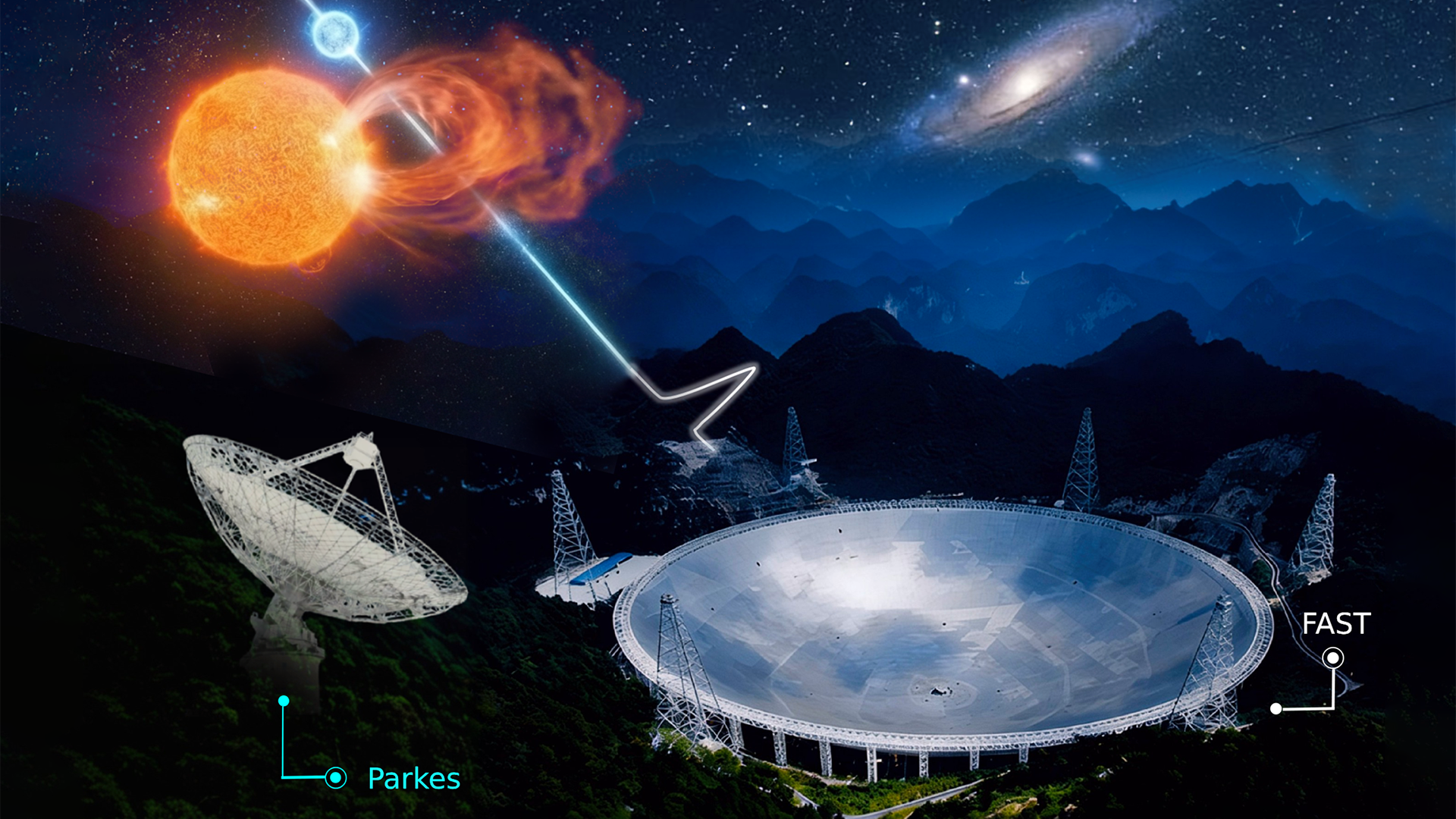
An international team of astronomers, including a researcher from the Department of Physics at HKU, has uncovered the first decisive evidence that at least some fast radio burst (FRB) sources – brief but powerful flashes of radio waves from distant galaxies – reside in binary stellar systems.
This means the FRB source is not an isolated star, as previously assumed, but part of a binary stellar system in which two stars orbit each other.
“This finding provides a definitive clue to the origin of at least some repeating FRBs,” said Professor Bing Zhang, Chair Professor of Astrophysics of the Department of Physics and Founding Director of the Hong Kong Institute for Astronomy and Astrophysics at HKU, and a corresponding author of the paper. “The evidence strongly supports a binary system containing a magnetar – a neutron star with an extremely strong magnetic field, and a star like our Sun.”
Using a Five-hundred-meter Aperture Spherical Telescope (FAST) located in Guizhou, also known as the ‘China Sky Eye’, the team detected a distinctive signal that reveals the presence of a nearby companion star orbiting the FRB source. The discovery, published in Science, was based on nearly 20 months of monitoring an active repeating FRB located about 2.5 billion light-years away.
Changes in the polarisation properties of radio waves can reveal the environment around an FRB source. The team observed a rare phenomenon known as an ‘RM flare’ – a sudden and dramatic change in the polarisation properties of the radio signal, likely caused by a coronal mass ejection (CME) from a companion star that contaminates the environment of the FRB source.
Fast radio bursts are millisecond-long but extraordinarily bright radio flashes from beyond our Milky Way galaxy. While most FRBs are observed only once, a small fraction repeat, offering rare opportunities for long-term study and making it possible to detect unusual changes over time. These repeating sources have been closely monitored by FAST since 2020 through a dedicated FRB Key Science Programme co-led by Professor Zhang.
FRBs are known for their near 100% linear polarisation. As radio waves travel through a magnetised plasma, their polarisation angle rotates with frequency – an effect known as Faraday rotation, measured by the rotation measure (RM). “One natural explanation is that a nearby companion star ejected this plasma,” explained Professor Zhang.