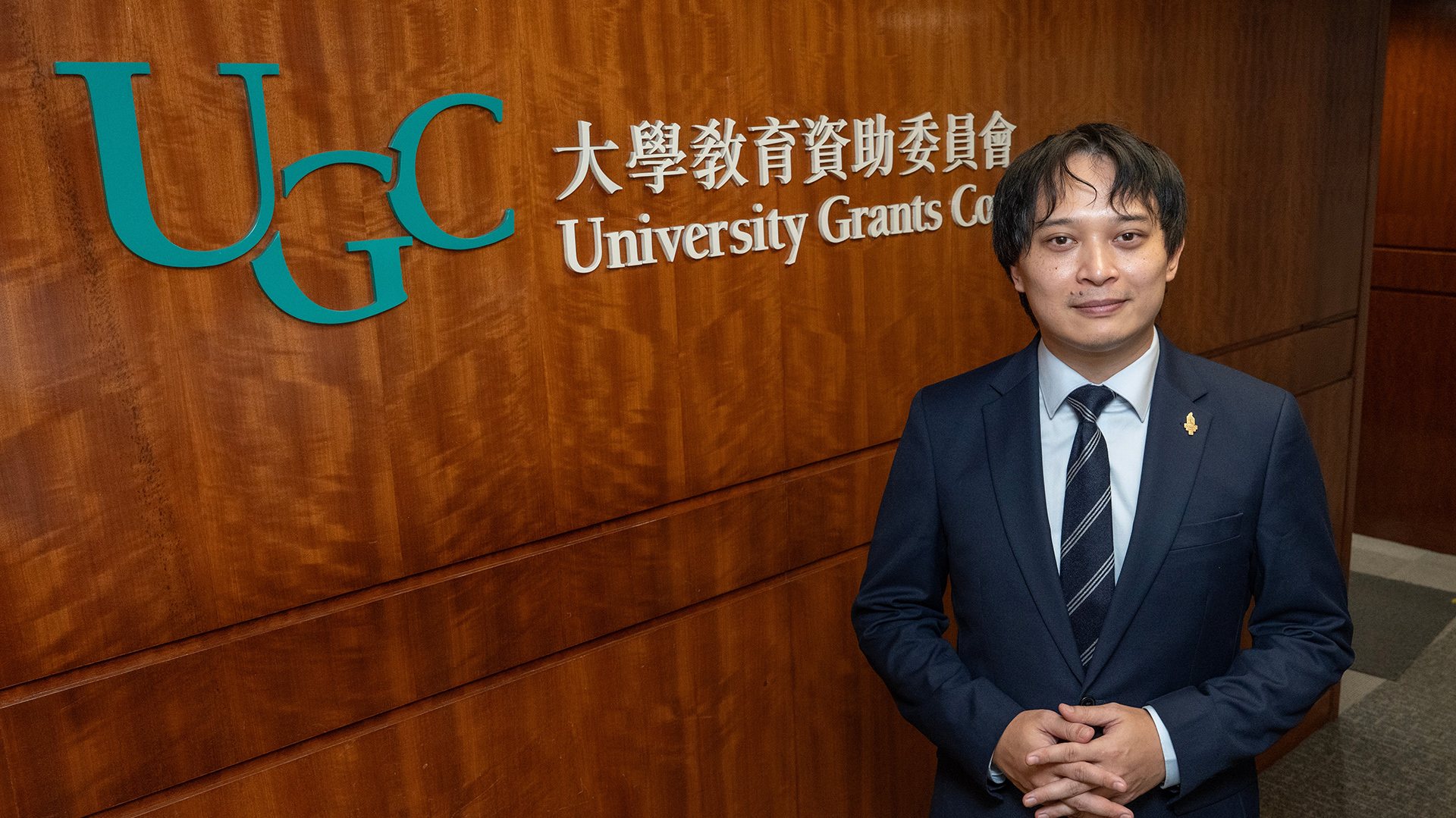
“Why is it that we all come in different shapes and sizes?” This was a question posed by a friend of Dr Michael Rivera, Lecturer in HKU’s Faculty of Social Sciences, and recipient of the 2026 UGC Teaching Award (‘Early Career Faculty Members’ category) from the University Grants Committee (UGC).
And who better to ask, since Dr Rivera is Hong Kong’s first biological anthropologist, whose main research focusses on how humans have evolved and adapted biologically and culturally over the last six million years. His PhD research at the University of Cambridge involved reconstructing the diets, health profiles, physical activities and body shapes of ancient humans.
“I study human skeletons that are hundreds or thousands of years old,” he explains. “If you laid out an archaeological skeleton in front of me, I could tell you, for instance, how old that person was when they died, whether they were healthy, what they ate, what kind of physical activities they did.” His research has delved into how active and healthy the lifestyles and diets were of ancient peoples living in coastal environments – particularly in East and Southeast Asia, and in the Baltic region of northeastern Europe.
Dr Rivera is currently working on promoting interdisciplinarity and bioanthropology in Hong Kong, in terms of research, teaching, laboratory and field projects, and public engagement initiatives. This involves establishing and bringing together various strands of academic inquiry, including media and cultural studies, genetics, biology and anatomy, animal ecology and environmental conservation, as well as history and Hong Kong studies. He was also the lead archaeologist managing the investigation of a US Navy plane that crashed in 1945 during World War II.
As a Filipino-Chinese who grew up in Hong Kong, Dr Rivera is interested in issues of race and identity, and is involved in social education and antiracist advocacy in Hong Kong and worldwide. He is the Chair of the Education, Research and Culture Committee of the Network for Philippine Studies in Hong Kong (NEPS-HK). He has worked in and has projects in Indonesia, Thailand and the Philippines, and was co-director of Sisig and Puchero, a short documentary film in 2021 covering themes of migration, food, entrepreneurship, and Filipino culture.
At HKU, his course on race and racism issues covers the local and the global, the historical and the contemporary, and the scientific and sociopolitical understandings of race. Students achieve a critical consciousness and transformation through the course, becoming confident to engage thoughtfully with race in Hong Kong and beyond. “This course is the first in Hong Kong and the most unique in all of Asia, merging elements of critical race theory with story-sharing and antiracist praxis,” he says. “As an educator in Hong Kong, I find endeavours to challenge our reliance on concepts and histories from abroad, and instead centre the local context, demand that we welcome the voices of different stakeholders into our discourse – particularly those of racialised students, recent immigrants and migrant workers, refugees and asylum seekers, and this generation’s diverse youth.”
He also teaches a Common Core course about human variation and evolution called ‘All You’ve Ever Wanted to Know About Humans’. “I had dreamed of teaching this course for about 15 years prior, until I was finally given the chance at HKU,” he says, perhaps with his friend’s question in mind. It is a showcase of his field, featuring primatology, human evolution (behavioural and biological), genetics and living human biology, osteology, palaeopathology, forensics, archaeology, the history of race and racism ideas, the history of the discipline of anthropology, current research in Hong Kong and Asia, and science communication.
Students taking the course quickly understand that this was not any orthodox class primarily based on listening to lectures. “I feel my life purpose when students engage with its content and find its rewards, either for knowledge, for skills, or for fun,” Dr Rivera says. So his students find themselves becoming the ones who activate the course content, which includes hands-on, inquiry-based labs where they handle skeletal material and learn methods used in bioarchaeology and forensic science. “These designs help them confront misconceptions about human development, and develop ethical thinking and a sense of civic duty over scientific information. They also learn how anthropological science contributes to important causes,” he explains.
The course also offers an opportunity for students to explore areas of the discipline overseas, and took Andrew Kung Kai-sheng, a Bachelor of Arts (Humanities and Digital Technologies) student to Manila in 2025 for a field trip, where he got the chance to meet different experts and students at the School of Archaeology at the University of Philippines Diliman, and learned more first-hand about the major archaeologists in the Philippines and their influence in the development of the discipline. “This tour designed by Dr Rivera allowed me to take my classroom knowledge of archaeological science and bioanthropology further in another context,” he observed.
In addition to the Common Core and regular courses he teaches, Dr Rivera’s commitment to enhancing the teaching of public engagement skills can also be seen in ENGAGE – for Empowering New Generations for Action, Growth, and Engagement – a pilot project that he leads under the ‘Enhancing public engagement and outreach training across HKU curricula’ initiative supported by UGC’s Teaching Development and Language Enhancement Grant. “Together with colleagues across the University, we hope to promote and enhance curricula that give students training in media skills and communication ability. We have already begun securing collaborations in the Faculties of Social Sciences, Education, and Science, where students are being given feedback and encouragement to increase their confidence communicating to public audiences,” he says.
Humanistic care-centred teaching is at the heart of Dr Rivera’s classes. “Drawing on care theorists and recent higher education scholarship, my courses are embedded with care ethics, which emphasise values of respect, trust, responsiveness, empathy, and community-building in university teaching,” he notes. “I treat teaching as a relational practice, rather than content delivery or training for work readiness. Assignments and course activities are designed to foreground emotional health, holistic development, and inclusive values, to ensure students feel seen and supported.” He also seeks to promote community-centred and publicly-engaged teaching as an important imperative for the future of higher education.
Introduced in 2011, the UGC Teaching Awards are presented annually to recognise and honour teachers for their outstanding teaching performances, achievements, leadership, and scholarly contributions to teaching and learning at UGC-funded universities and institutions.
With this prestigious UGC Teaching Award building on the acclaim from the University’s Early Career Teaching Award he was presented with in 2025, Dr Rivera says: “Providing high-quality and holistic education to students is an imperative for us teachers. I am excited to meet other determined educators with UGC’s support and collaborate to make Hong Kong a centre of compassion-based teaching.”
“I put students at the centre of my teaching, by trying to understand all aspects of who they are, what they care about, and what they want to do in the future,” he adds. “And I look forward even more to seeing how they will take their learning and make a positive difference in the world.”