“In an era defined by disruption and interdependence, collaborative governance is not just important – it is essential.” Even a cursory glance through any news on world affairs and current issues these days will seem to validate this claim by Professor Kenneth Wong, Kerry Group Professor in Public Policy at HKU.
Professor Wong is also the Director of the University’s new School of Governance and Policy (SGP) – an interdisciplinary nexus reflecting the multipolar world it is designed to work with – combining global intellectual leadership and cross-disciplinary expertise, founded on five core research pillars spanning global governance, urban policy, and leadership, and is dedicated to shaping the future of governance and public policy.
The School is a joint venture of the Faculties of Business and Economics, Social Sciences, and Law, and will offer a signature Master of Governance and Policy degree starting this September, an Executive Leadership Hub, and specialised policy institutes designed for undergraduates. By integrating the strengths of the disciplines of the social sciences, business, and law, as well as bringing together the Asia Global Institute and the Centre on Contemporary China and the World under one umbrella, SGP will create a unique academic environment for training leaders and managers to tackle challenging global issues, such as climate change and trade relations.
The Master of Governance and Policy has been structured to strengthen students’ skills in policy analysis and broaden their understanding of different policy environments, with core courses on both geopolitics and financial and economic issues. Students, who will be drawn from a range of disciplines and countries, will also take electives from across the University, anything from public health to AI governance, and go overseas to learn from policy practitioners on-site. A standout aspect of the programme is its practical component – students will work on projects with government bodies and non-profit organisations, connecting academic learning with real-world challenges faced by policymakers. Students will also come away with an understanding of how to implement policies and new initiatives, while engaging with stakeholders across different fields and points of view.
Professor Wong added: “The question is how we can use research to improve areas such as trade relations, housing policy and social welfare, so that people on the ground benefit.”
An Executive Leadership Hub is also planned for practitioners in government and the profit and non-profit sectors so they can tap into the School’s expertise in areas such as economic planning, governance and sustainability. Government officials from the Association of Southeast Asian Nations (ASEAN) will likely be a first target, but the aim is to be open to the world.
“We are trying to fill a gap where we see a world with increasing polarisation, distrust of the public sector, and concerns about the quality of governance,” says Professor Wong. “These issues are arising not only in individual nations but worldwide. With our School, we see an opportunity to be a global hub to address some of these major concerns.
“At a juncture where rapid technological leaps are reshaping our world, the establishment of the School of Governance and Policy reaffirms the essential role of the humanities in the future,” noted HKU President and Vice-Chancellor, Professor Xiang Zhang. “Governance is not a mechanical process; it is a weight of responsibility that demands historical depth, ethical clarity, and a profound understanding of mankind. By uniting academic insight with real-world action, we are shaping a new legacy of leadership that ensures our collective advancements always serve the true progress and fundamental well-being of the global community.”
Providing counsel on the SGP’s direction is an International Advisory Board that includes world-renowned figures, such as Nobel Laureates in Economics, influential global economists, distinguished elder statesmen and senior officials.
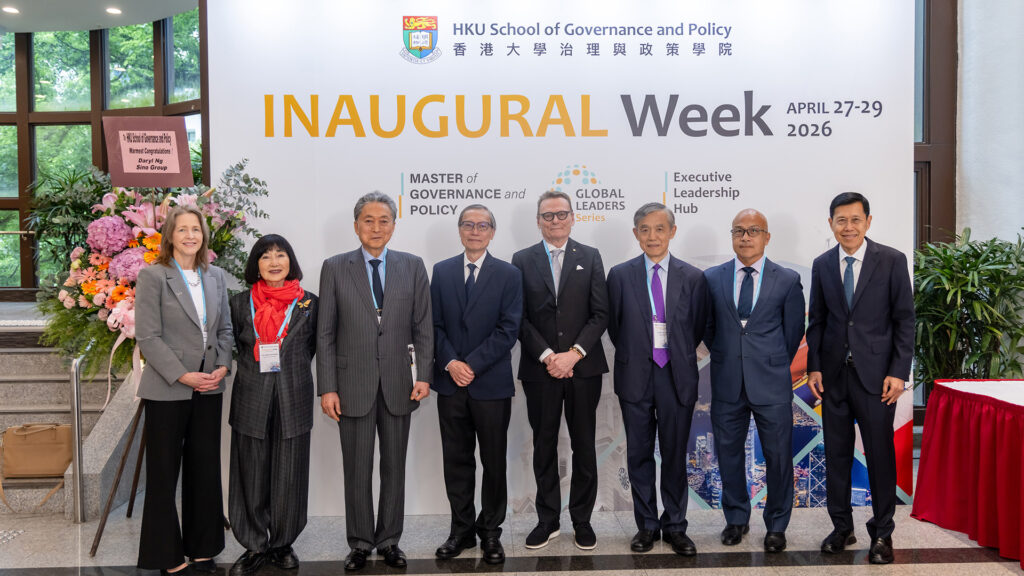
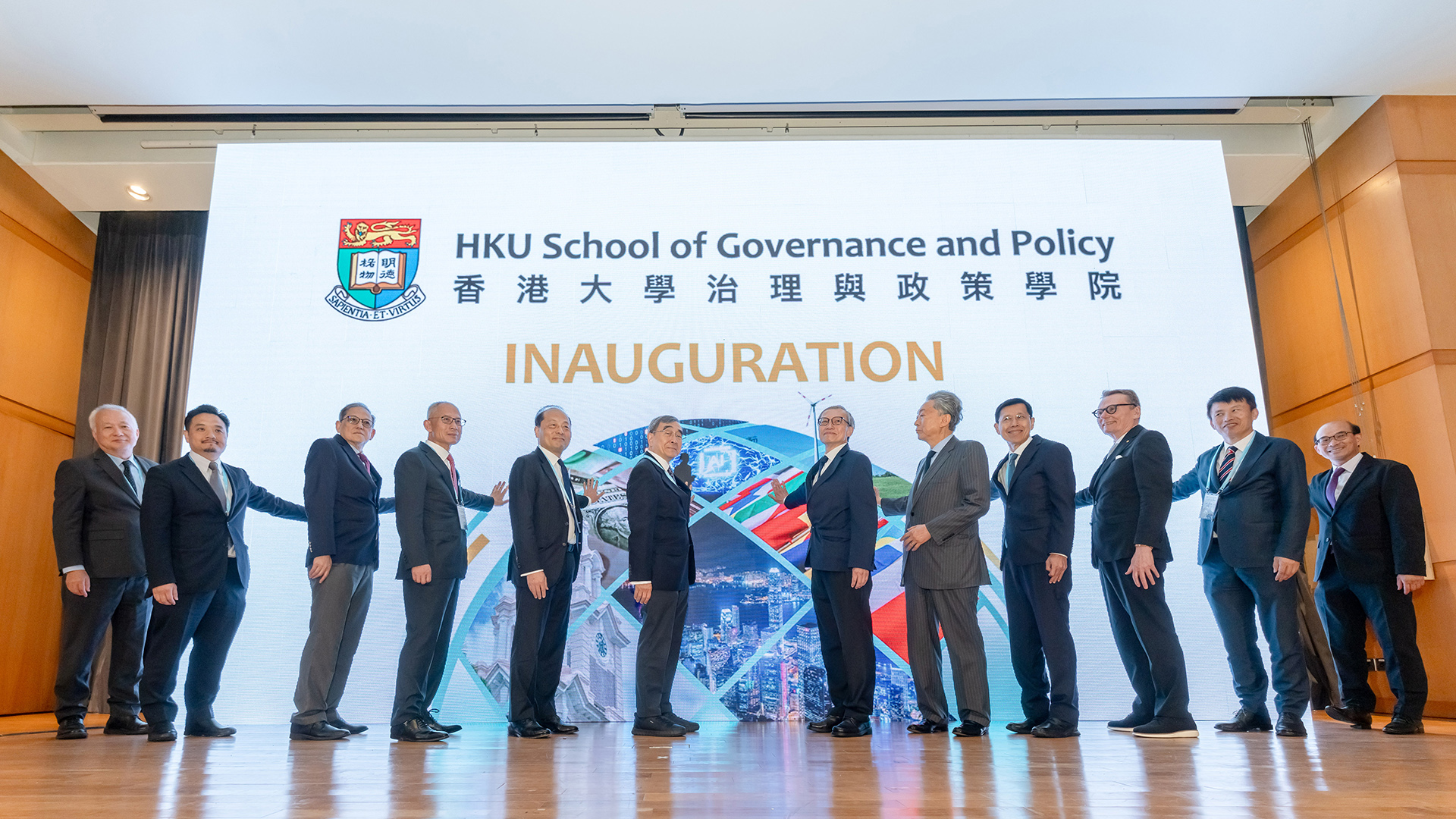
Many of these elite experts were in attendance at the SGP’s three-day Inaugural Week held in late April, which drew over 900 attendees to the HKU campus. The keynote address was delivered by Professor James Robinson, 2024 Nobel Laureate in Economics, who observed that the School is uniquely positioned to demonstrate how the East Asian development experience has redefined conventional social science intuitions. He noted that recognising cultural nuances is not only essential for effective public policy but represents one of the most exciting frontiers in modern social research.
A centrepiece of the week was the launch of the Global Leaders Series, featuring an address by Dr Yukio Hatoyama, who was conferred an honorary professorship during the event. Discussing ‘The Future of Sino-Japanese Relations Amid a Cracking World Order’, Dr Hatoyama emphasised that the stability of East Asia is a linchpin for international security. He urged for renewed diplomatic stewardship to halt global instability and foster regional cooperation.
The comprehensive inaugural programme also featured high-level panel discussions and lectures from esteemed academic leaders, including Professor Joseph Liow, Dean of the Lee Kuan Yew School of Public Policy at NUS; Professor Lan Xue, Dean of Schwarzman College at Tsinghua University; and Professor Carole Roan Gresenz, Dean of the McCourt School of Public Policy at Georgetown University, alongside Mr Phongthep Thepkanjana, former Deputy Prime Minister of Thailand.
Consistently underscoring these initiatives is SGP’s commitment to bring experts from outside the University and from a variety of perspectives to share their views and promote discussion.
“Our mission is to establish SGP as Asia’s leading hub for global governance and policy leadership. By leveraging our unique cross-disciplinary edge, we provide a platform for evidence-based policy innovation in a multipolar world, fostering collaborative solutions that unite nations and communities,” says Professor Wong. “We want to be an international hub, a bridge between East and West, and create public space for open dialogue on challenging issues. We feel this can be a very important forum and learning opportunity. There are very few places in the world with Hong Kong’s advantages and assets. I think being in HKU really puts our School in a unique position to do work that makes a real contribution to the policy world.”