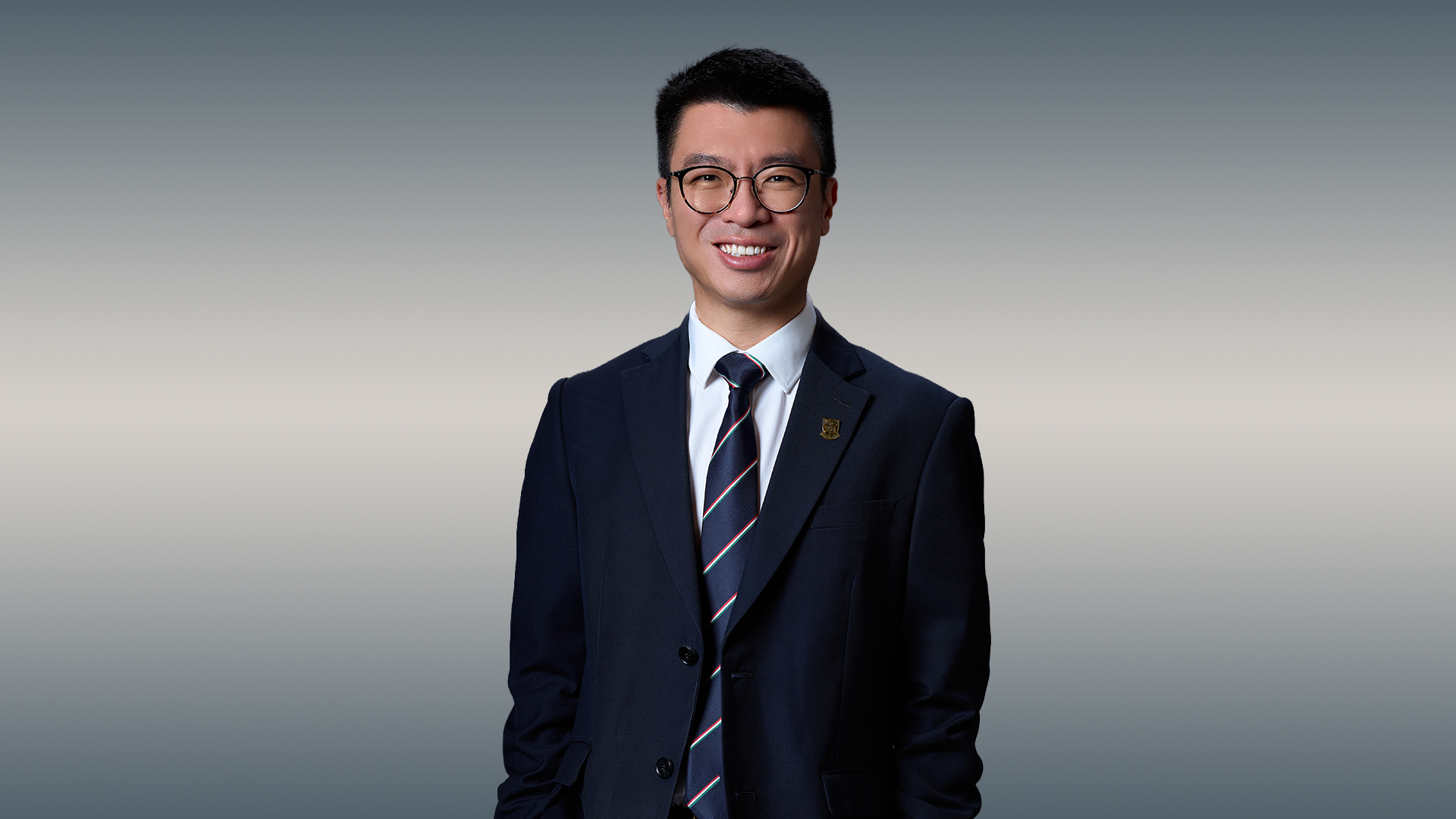
As Professor Anderson Shum Ho-cheung steps into his role as the University of Hong Kong’s Vice-President and Pro-Vice-Chancellor (Research), he is doing more than taking on a critical administrative leadership position – he is coming back to his roots. Born and raised in Hong Kong, Professor Shum spent his formative years in the city before earning a Bachelor of Science in Engineering degree in chemical engineering from Princeton University, followed by a Master of Science and PhD in applied physics from Harvard University. He subsequently began his career as an academic here at HKU. Today, his return marks a homecoming that bridges world-class scientific expertise with a deep commitment to shaping the University’s future.
Discover Professor Shum’s vision for expanding HKU’s global research footprint, empowering the next generation of students, navigating interdisciplinarity, and ensuring that the University continues to serve as an enduring, impactful bridge between Hong Kong and the world.
Q: Why were you inspired to take up this position of Vice-President and Pro-Vice-Chancellor (Research) at HKU, and what are you hoping to do with it?
A: As someone born and bred in Hong Kong, I can personally relate to how the University is very dear to the hearts of generations of Hong Kong people. Having the opportunity and honour to return and take on such an important position is amazing. The research and innovation portfolios are at the heart of Hong Kong’s next phase of development, and being able to be part of it feels like witnessing history.
I was trained as a chemical engineer during my undergraduate studies at Princeton, and chemical engineers consider a lot of things as flows. I have always thought of Hong Kong as a conduit with flows of different elements. Early on, these were flows of labour, goods, and people. Later, it grew to include professional services and capital, turning us into a leading international financial centre. Moving into the next phase, the vital flows will be technologies, knowledge, and high-calibre talent. Universities are at the centre of this transition, and HKU holds a special place in the region. If HKU does well, Hong Kong will do even better.
Because I started my independent academic career at HKU, there is also a genuine feeling of returning home. I know firsthand the immense potential here for young academics to build their careers. Rejoining HKU at such a crucial time is a great honour, and I hope it can serve as an inspiring example for young people in Hong Kong.
HKU is already home to an extraordinary pool of world-class scholars and rising talent. I look forward to hearing directly from our established researchers and early-career faculty about their visions and aspirations. World-class scholars come to Hong Kong on a mission to build work of lasting impact, while rising stars are looking to forge illustrious careers. My fundamental responsibility as Vice-President is to align university strategy with their ambitions, removing barriers and providing the support they need to lead globally.
Q: What do you see as the primary strengths here in terms of research and innovation?
A: One of the most vital needs for a university is to attract high-quality students. HKU has traditional strengths in fundamental research and is home to many outstanding homegrown scientists. Now, with our growing ability to draw world-class researchers – including Nobel Laureates and a Field Medallist – HKU can recruit even better students, postdocs, and research staff from across the globe. That international talent pool acts as an engine of growth, driving Hong Kong’s future through research, technology, and talent development.
Q: Are there specific disciplines that you feel are the core focus going forward?
A: Boundaries across traditional disciplines are becoming increasingly blurred because the most pressing global challenges are inherently cross-disciplinary, multidisciplinary, and interdisciplinary.
HKU’s greatest strength lies in being a comprehensive university. We host a range of traditional Faculties alongside newly established interdisciplinary schools like the School of Computing and Data Science, the School of Future Media, and the School of Biomedical Engineering. The coexistence of these diverse fields is exactly what is needed to address future societal needs.
With artificial intelligence, entry barriers to traditional fields are lowering, allowing non-experts to engage meaningfully in cross-disciplinary projects. For instance, by using AI tools, a medical doctor may not need deep engineering expertise to collaborate effectively on new medical technologies. Rather than clinging strictly to century-old definitions of disciplines, we should leverage these tools to amplify collaboration across all subject areas.
Q: What specific ideas do you have to foster these strengths and broaden HKU’s global impact?
A: While these ideas are subject to ongoing discussions with senior management and Council, I believe HKU must leverage its unique leadership position to reach new heights of excellence. HKU is already a premier institution locally and regionally, but true global leadership requires creating lasting, worldwide impact.
We want to catalyse research projects that carry global influence, span multiple institutions, and generate valuable knowledge that serves the global community for decades to come.
Furthermore, we should connect experts across all fields – including non-STEM areas like the arts, humanities, law, and business – to amplify our impact. In the past, HKU provided staunch support for the development of Hong Kong as a city. As Hong Kong steps into its next era, HKU should do what it can to ensure that the city continues to serve as an impactful bridge and conduit to the world. The goodwill we enjoy today as academics was built by past generations; our goal now is to innovate in a way that allows future generations of students and faculty to inherit similar benefits.
Q: How do you see the value of interdisciplinarity in today’s research landscape?
A: My own academic trajectory spans multiple fields. I studied chemical engineering as an undergraduate at Princeton, completed my graduate degrees in applied physics at Harvard, started at HKU in mechanical engineering, and later worked across biomedical engineering, chemistry, and materials science. My work on microfluidics and soft matter naturally intersects physics, chemistry, biology, and engineering.
Historically, multidisciplinary researchers faced an identity crisis because traditional funding committees favoured narrow, single-discipline projects. If you applied for a physics grant, they might say you weren’t ‘physics enough’! Fortunately, the academic landscape has shifted. Today, there is far greater appreciation for problem-based research, which is almost always multidisciplinary by nature.
Q: How do you foster blue-sky research and translational research in your new role and what do you think should be done to keep both?
A: First and perhaps foremost, I think it is more important to distinguish between good research and not-so-good research. I would say ‘fundamental’ and ‘applied’ only refer to different stages of the whole research value chain. What is seemingly fundamental today could be tomorrow’s next-generation technologies. I want our government, funding agencies and industry partners to appreciate this, so there will be sufficient and sustained support throughout the value-chain system.
Q: Do you think the government initiatives, along with the broader ecosystem now, are creating a favourable environment for researchers and for all universities?
A: Hong Kong is currently experiencing a surge in research and innovation growth unlike any other period in its history, and there is no sign of it slowing down. It’s becoming clear that both the Hong Kong SAR Government and the Central Government want Hong Kong to develop a new engine for economic and societal growth. As a result, research and innovation, supported by talent development and attraction, are a top priority. This direction is reflected in Hong Kong’s exciting new development in the Northern Metropolis, which emphasises higher education, research, innovation, industry, and partnerships as part of the broader 15th Five-Year Plan. The takeaway is that when governments set a clear strategic course, initiatives follow – and those who align early can progress faster with the momentum.
While many academic powerhouses worldwide are facing reductions in research funding, support, or manufacturing integration, Hong Kong is in a uniquely advantageous position. Public and private investment in research is expanding, we are adjacent to major industrial supply chains and markets, and we remain open and welcoming to global talent. For anyone serious about making an impact in research and technology, this is an opportunity that should not be overlooked – and HKU stands ready at the very forefront of this movement.
Q: How do you view the importance of research integrity and ethics?
A: Research integrity and ethics are absolutely foundational. Without rigorous ethical standards, we risk losing the public trust required to sustain investment in higher education and research.
Moreover, scientific progress relies on trust in discoveries and technological advances. Lacking proper protocols and responsible conduct, new findings face scepticism, knowledge creation stalls, and valuable public and institutional resources are wasted. Upholding research integrity ensures that our work remains credible, transformative, and worthy of public confidence.
Q: How will HKU continue to foster innovation and entrepreneurship to accelerate impact beyond the campus?
A: HKU is a powerful platform, but our physical space, funding, and manpower are inherently finite, whereas our ambition is limitless. This brings us back to the concept of a conduit. That’s why it is so important for a place like Hong Kong – it does not need to be big because value flows through it in all directions.
Our role is to enhance, empower, and diversify the speed and nature of those flows. In addition to traditional scientific publications, we are expanding pathways for start-ups, new technologies, patents, trademarks, and strategic partnerships through the newly established HKU RISE – which stands for Research, Innovation, Strategic Partnerships, and Entrepreneurship. Not every idea or enterprise has to originate or permanently remain on campus. If researchers, entrepreneurs, or industrial partners come to HKU, get inspired, co-create solutions, and build major ventures elsewhere, that still represents a tremendous contribution by HKU to the global ecosystem. Effective conduits are, by design, limitless in their reach.
Q: How do students fit into your vision for research and innovation?
A: Students are key stakeholders in a university, where knowledge is being actively created and transferred at the same time, and that process of creation is research.
For an educational experience to be truly transformative, every student, whether undergraduate or postgraduate, should have the opportunity to witness, participate in, and contribute to cutting-edge research. Imagine being a student working alongside scientists during a groundbreaking discovery; it gives you a perspective and a passion that will last a lifetime. By involving students directly in global research projects, we deliver the most compelling education possible.
Q: What originally drew you to science and engineering?
A: As a child, I briefly dreamed of being a lawyer, but realised I was not particularly drawn to fast-paced courtroom arguments. Medicine was another popular path in Hong Kong, but I knew early on that I didn’t much want to deal with blood!
I was naturally drawn to science and was quite good at that, and I recognised that an engineering mindset equips you with quantitative analytical power and practical problem-solving skills. I knew those core skills would prove invaluable regardless of my eventual career path.
Once I got into engineering research, I realised how uniquely satisfying it is. In research, you get to work on questions that no one else in human history has answered before, while directly addressing real-world problems. That sense of discovery is a rare privilege.
Q: What role does failure play in a researcher’s growth, and can you share an example of how it helped you?
A: The common definition of failure is simply that you have a certain objective, but you are not able to achieve or meet it. That is what is commonly perceived as failure. However, even if you fail, you can learn a lot from it. The learning might be about how to better achieve the outcome you desire next time, or it might teach you to modify the outcome you expected. I think that is something you can use as a way to achieve greater success.
My personal example is from when I first started doing research during my third year at Princeton. That was when I had an independent project supervised by two world-class professors. I was asked to study how small molecules, known as surfactants, assemble on a metal surface and whether they can slow down corrosion of the metal. I was then tasked with visualising the pattern of the surfactant molecules on the metal surface. It was an impossible task because no one had done it before.
In fact, I failed every day. I worked really hard, starting in the morning and finishing around one or two in the morning, for nine consecutive months, with nothing to show. Sometimes I would see something and think it might be real, but it would turn out to be artifacts. In the end, I saw something that nobody had seen before. I was so happy and so proud! That level of satisfaction made me realise that, besides research, there is no other job that can give me the same kind of satisfaction. And so, I decided to go to graduate school afterward.
Q: As Vice-President, will you have to step back from your own research, and how do you plan to balance these roles?
A: Having served in leadership positions previously, I have already gone through the initial process of recalibrating my research activities. It requires continuous coordination with my research group, collaborators, and industry partners.
While I have had to scale back daily operational flexibility, taking on an administrative role with a holistic overview offers valuable strategic benefits. Overseeing research and innovation at an institutional level broadens my perspective, allowing me to be far more strategic in selecting the research directions my own lab pursues. The administrative and academic mindsets end up enriching one another.
Q: How do you like to relax outside of your academic and administrative duties?
A: When time permits, I enjoy getting some exercise through running or jogging. Most importantly, I prioritise spending quality time with my family.
I have two children: a 14-year-old son and a 12-year-old daughter. They frequently ask me fascinating, unexpected questions. When I find myself unable to answer them simply, it reminds me that I may not understand the subject as deeply as I thought, which gives us a fun opportunity to explore the answer together.