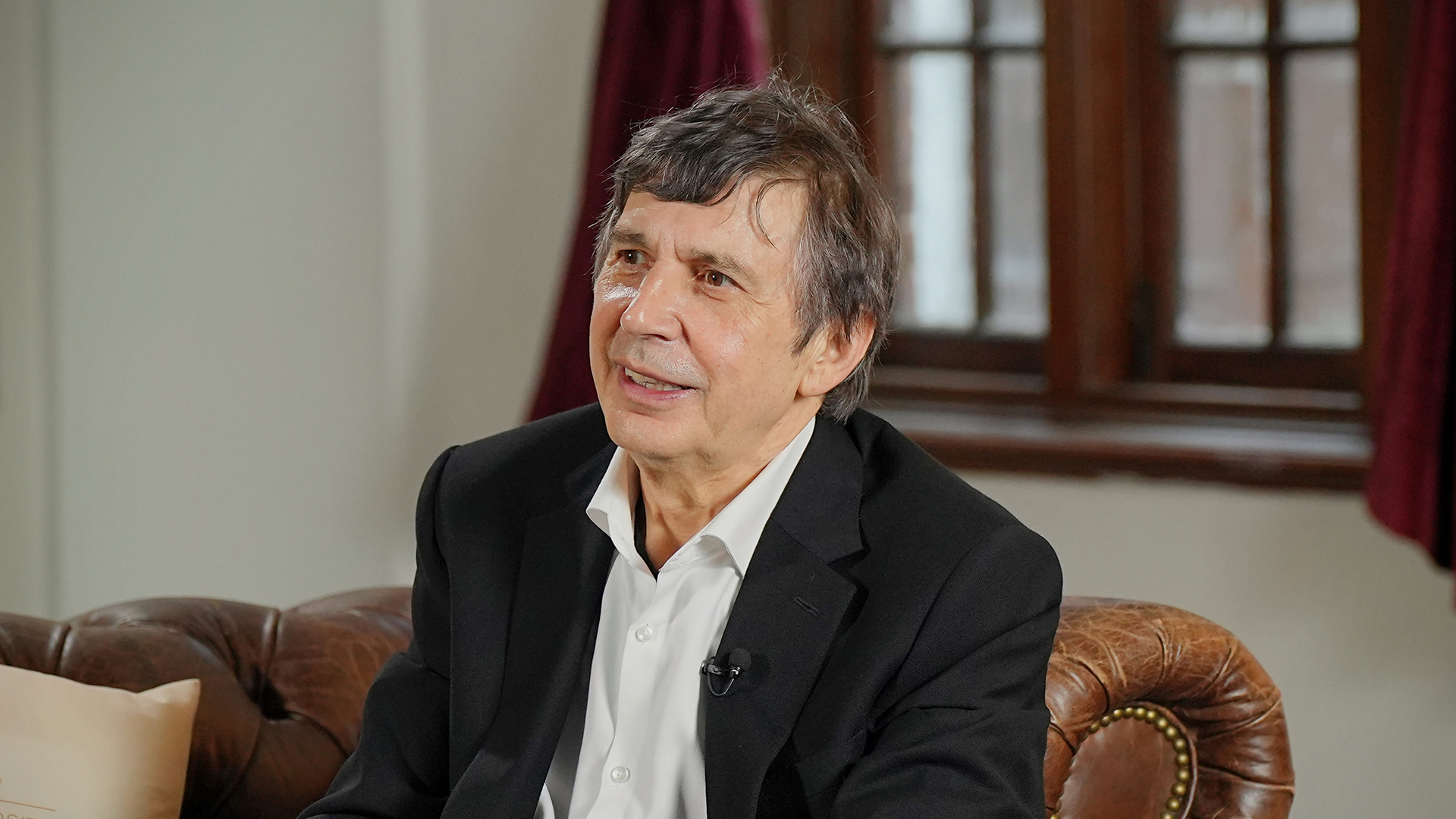
By enabling the fastest motions in nature to be captured and recorded, Professor Ferenc Krausz’s groundbreaking attosecond technology brought him international respect and acclaim, including the 2023 Nobel Prize in Physics.
Having joined HKU last November as Chair of Laser Physics in the Department of Physics, Professor Krausz’s reputation continues to grow globally. Recently, he was elected as an International Member of the US National Academy of Sciences (NAS), in recognition of his outstanding contributions to ultrafast laser science and attosecond physics.
“Professor Krausz’s work has fundamentally redefined the boundaries of what we can measure, allowing us to witness the swiftest processes in the physical world,” observed Professor Xiang Zhang, HKU President and Vice-Chancellor. “His election is a profound recognition of a scientist who looks where others once thought it was impossible to see. At HKU, we strive to be a home for the pursuit of fundamental truths, with a view to inspiring the next generation of scholars to push beyond the established limits of human knowledge.”
Professor Krausz’s international membership was part of NAS’s recent announcement of the election of 120 members and 25 international members in recognition of their distinguished and continuing achievements in original research. Reflecting on the honour, Professor Krausz said: “I am deeply grateful for this recognition from the National Academy of Sciences. It reflects many years of collaborative work, and I look forward to continuing to advance attosecond science and its applications.”
A Hungarian-born Austrian physicist and a pioneer of attosecond science, Professor Krausz is widely recognised for pioneering attosecond metrology, enabling the observation of electron dynamics on their natural timescales. His work has opened new frontiers in physics, chemistry, and materials science, with far-reaching implications for both fundamental research and technological innovation.
Professor Krausz earned his doctorate in laser physics with distinction from the Vienna University of Technology in 1991 and completed his habilitation in 1993. He continued his academic career at the Vienna University of Technology, where he joined as an assistant professor in 1996 and was promoted to full professor in 1999. Since 2004, he has been holding leadership roles as Director of the Max Planck Institute of Quantum Optics and as Chair of Experimental Physics – Laser Physics at Ludwig Maximilian University (LMU) in Munich. He founded the Centre for Advanced Laser Applications in Munich in 2015 and the Center for Molecular Fingerprinting (CMF) in 2019.
Looking ahead, Professor Krausz continues to push the boundaries of what can be measured, and this time, it’s human health. With the Center for Molecular Fingerprinting, Professor Krausz took the lead in establishing a new type of large-scale prospective longitudinal cohort study, ‘h4h.hu’, aimed at laying the foundations for personalised preventive healthcare. To this end, he recently initiated a global alliance ‘Protecting.Health’, bringing together CMF, LMU and HKU.
Using attosecond technology, he and his team developed a screening method that identifies minuscule changes in the molecular composition of human blood – like an ‘infrared fingerprint’ to flag various cancers and chronic conditions, such as diabetes, at the earliest stages. The method is cheap, comprehensive, non-invasive and risk-free, making it easy for people to be screened every year.
Having tested the technology in Hungary over the past decade, he is now preparing to replicate that study here in Hong Kong, working closely with HKU’s world-class Clinical Trials Centre and other faculties and universities in the city, and run a parallel study in Germany.
“If everything goes according to our plans, then by 2035 we should have this screening algorithm in place, and the healthcare systems of these three regions could start broad population screening,” he said. “I think it is not an exaggeration that this will catapult these three regions to the forefront of medical and biotechnological research and render them global pioneers of future personalised preventive care.”