In 2018, the Hong Kong authorities intercepted an illegal shipment of 88 dead pangolins. Who killed them? Where were they going? Was this a one-off case, or just one transaction in an ongoing smuggling racket? And how does Professor Timothy Bonebrake, Director of the School of Biological Sciences come into the picture?
Born and raised in Los Angeles, in the US, Professor Bonebrake became interested in wildlife at an early age. He holds a BS in Environmental Sciences from the University of California, Berkeley and a PhD in Biology from Stanford University, and his research has come to focus on examining and addressing tropical climate change impacts, global change, urban ecology, wildlife trade and endangered species management.
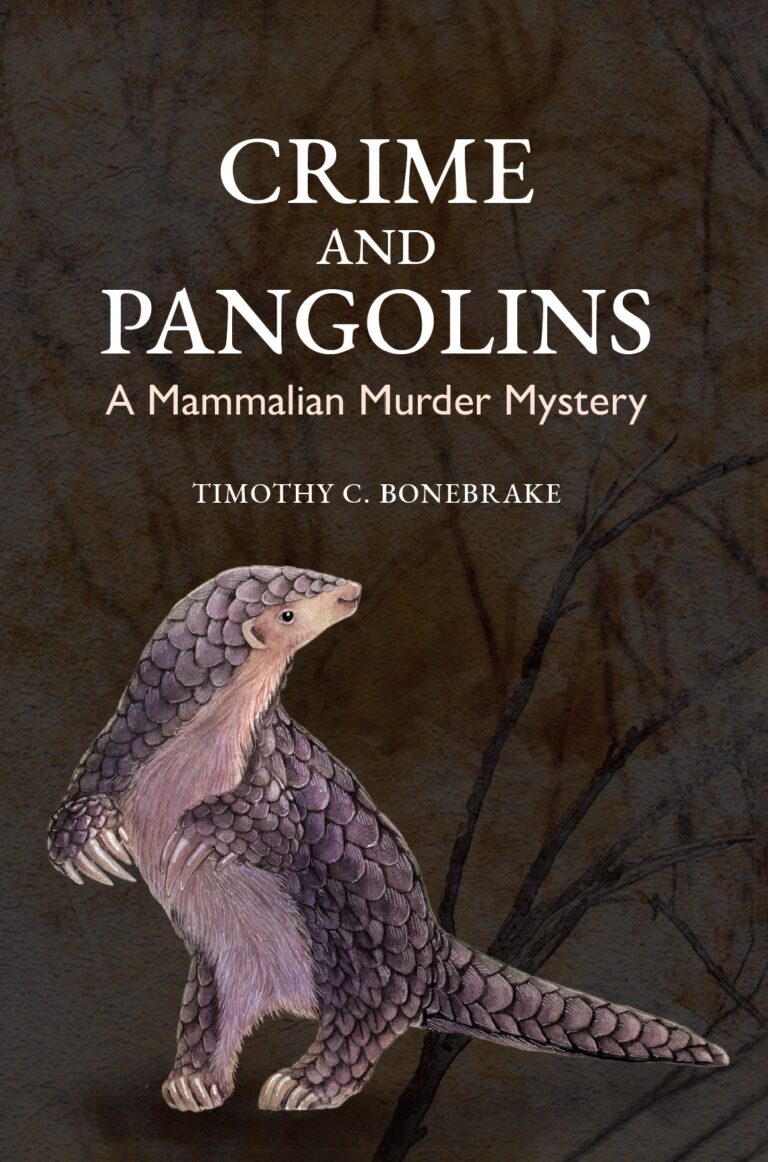
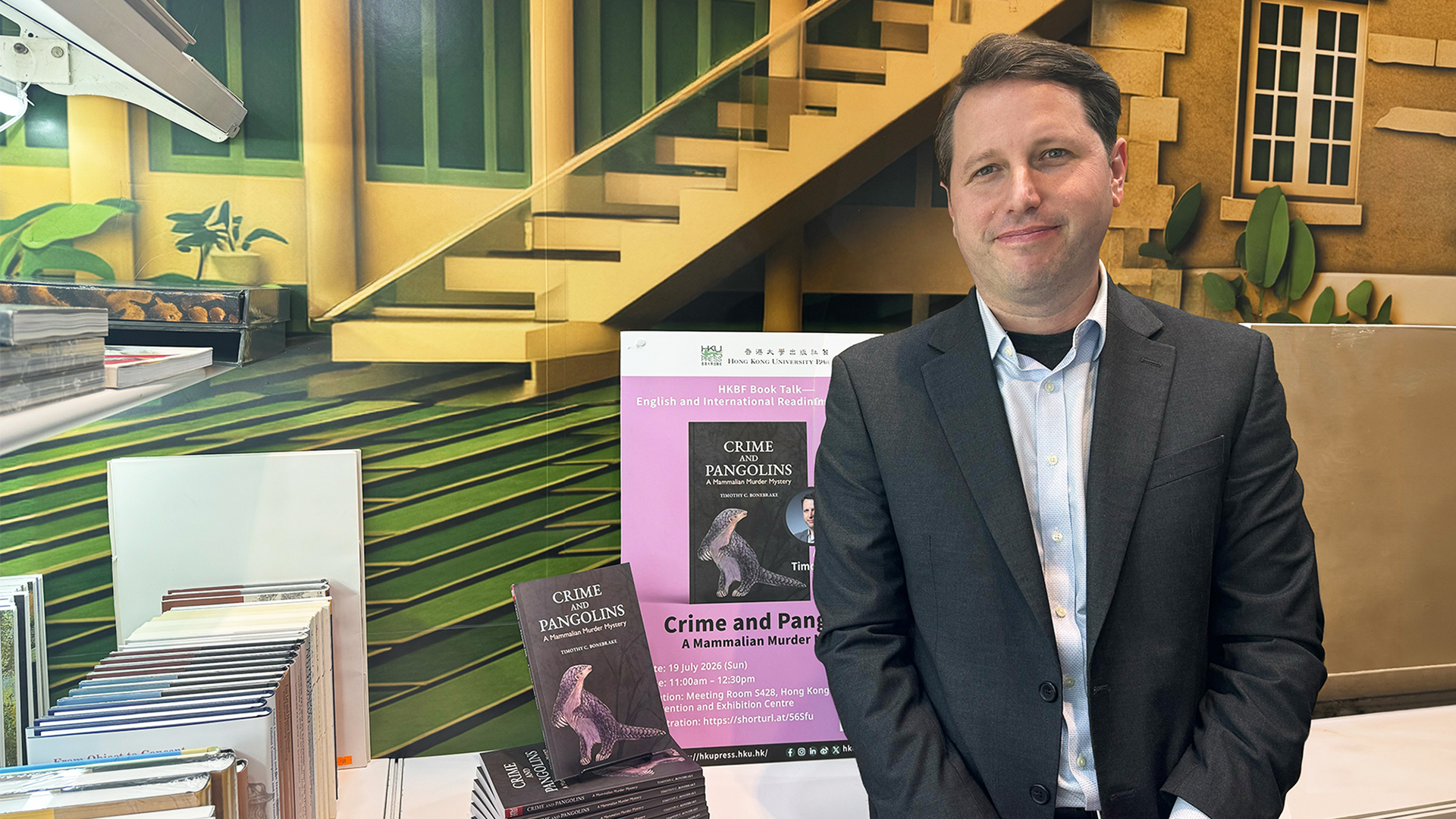
The impetus for transforming his scientific research into the murder mystery published by HKU Press, Crime and Pangolins: A Mammalian Murder Mystery, began in part because such a lot of his investigations seemed to extend beyond orthodox research expectations and publication formats.
He recalls vividly, for instance, the experience of arriving in Cameroon to conduct research and seeing for the first time the ubiquity of dead pangolins being sold openly on roadsides, strung up and dangling on display. “This was the sort of information that didn’t fit into academic journals,” he notes.
He adds that in his college days, he was greatly influenced by The Song of the Dodo by David Quammen, a 1997 work of scientific journalism on evolution and extinction that was part science, part history, and part personal essay. “He talks about science and the process of science,” Professor Bonebrake says of Quammen. “And I became attracted to the idea of talking about science to non-scientific readers,” he says, adding that he has written Crime and Pangolins in a way that he hopes will appeal to readers with little or no scientific background and encourage them to develop an interest in science.
In fact, Professor Bonebrake was thrilled when he discovered that David Quammen wrote a review for Crime and Pangolins, observing that: “The international traffic in pangolins is a vast and heartbreaking criminal enterprise against a group of wondrous, gentle, and almost defenceless creatures. Timothy Bonebrake tells that story and much more in this thoughtful, important book.”
There is yet another reason for his adoption of the crime-detection format. “Half of the top podcasts are about true crime,” he says with a grin. “In classic true crime, it’s usually an individual case and you have a detective who tells you what the facts of the case are, the evidence, the suspects. There’s a procedure to these types of documentaries and podcasts that’s similar to what I’m doing with pangolins. I too am trying to put together evidence, to piece together things, and look for suspects.”
“And while I am indeed looking at an individual case, it’s also a little more broad than that. I’m also looking at what’s causing the endangerment of pangolins as a species, who’s causing it, and what do we do about it? How do you impose sufficient consequences that you can deter those crimes?” he adds.
The book also explores the speculation surrounding the possible role of pangolins in the emergence of COVID-19, and more broadly, the relationship between wildlife trade and zoonotic diseases, with Professor Bonebrake introducing his readers to conservation researchers, public health experts, and organisations across Asia, Africa, North America, and Europe fighting to create a world in which pangolins can thrive again.
In fact, the scope of the book was so broad that, although he began writing it while on sabbatical, it eventually took him almost a year to complete it. Although he says he wanted to give up many times, he credits his wife for giving him the support and determination to see it through.
Professor Bonebrake’s narrative connects the illicit pipeline of poached pangolins directly to Asian ports via criminal syndicates, but the market demand caused by the use of their scales in traditional Chinese medicine (TCM) is another factor. His views on TCM have, however, undergone a significant revision during the process of investigation.
“I was quite naïve at first, I thought the whole usage of TCM as being rather silly,” he admits. TCM doctors were regarded as the ‘suspects’ in the crime, since they were the ones actively prescribing the use of the scales for curing diseases. Professor Bonebrake has dedicated an entire chapter to lead us through his process of discovery and re-evaluation of the role of TCM and its practitioners in the overall network.
“The use of pangolins in TCM goes back over a thousand years,” he notes, with reference in particular to the animal’s scales. “We have here, then, an ingredient in TCM that is versatile in treating a variety of different diseases. It would not be convincing to simply say ‘pangolin scales are not clinically proven to be effective’. But for me the important issue is that right now the usage of the pangolin scales is unsustainable. So whether it is or is not useful is not the most important thing – the point is that the scale of the exploitation of the pangolins is problematic.”
“So taking an antagonistic approach to the TCM community is sort of a non-starter, because if you talk to people in the industry and say, ‘Well, what you say is silly. You need to stop using endangered species,’ then they will just turn away and not talk to you. But if you approach the TCM scholars and ask, as I have, ‘What are the substitutes?’ They’ll acknowledge that there are lots of substitutes, and there are other products that have the same efficacy. So, let’s focus on those. I think that’s a more effective way of dealing with the overexploitation of pangolins in TCM.”
In trying to understand the overall mechanics of the illegal wildlife trade, Professor Bonebrake had to necessarily try to appreciate the legal and illegal aspects and actors involved. “I personally don’t study the criminal networks, but I relied on scholars who did,” he says. “But it’s true that I struggled with that knowledge, because it’s very different from what I do! I’m very happy talking about phylogenetic trees and evolutionary relationships, but when you start talking about all the different types of triad groups – which is very important for understanding the dynamics of illegal trade – that was a challenge and a real lesson for me. But it was an important part of the work.”
Have younger readers responded differently to the book or the usage of pangolins in TCM, compared to older ones? “There definitely are some generational differences,” he notes. “I’m more familiar with the issue of shark’s fin. Most of my students won’t touch it, but most of their parents do! We see similar things with TCM. But maybe as people get older, they may adopt more traditional ways and change their attitudes. So we can’t necessarily count on generational differences as a means for reducing usage in the long run,” he warns.
While he continues to study climate change on butterflies and insects, would he consider looking at the impact of climate change on pangolins? “There isn’t a lot of research or studies to date about pangolins and climate change. I think because most people are more focussed on the more pressing threat of exploitation, but I do think it’s a very important topic. From my research on butterflies, we know that they’re very sensitive to climate change, so it’s very easy to detect how they respond to it. It’s not so easy with pangolins, we can’t as readily detect those impacts, but I do think it’s important.” A potential future investigation then for Chief Inspector Bonebrake, perhaps? Stay tuned!