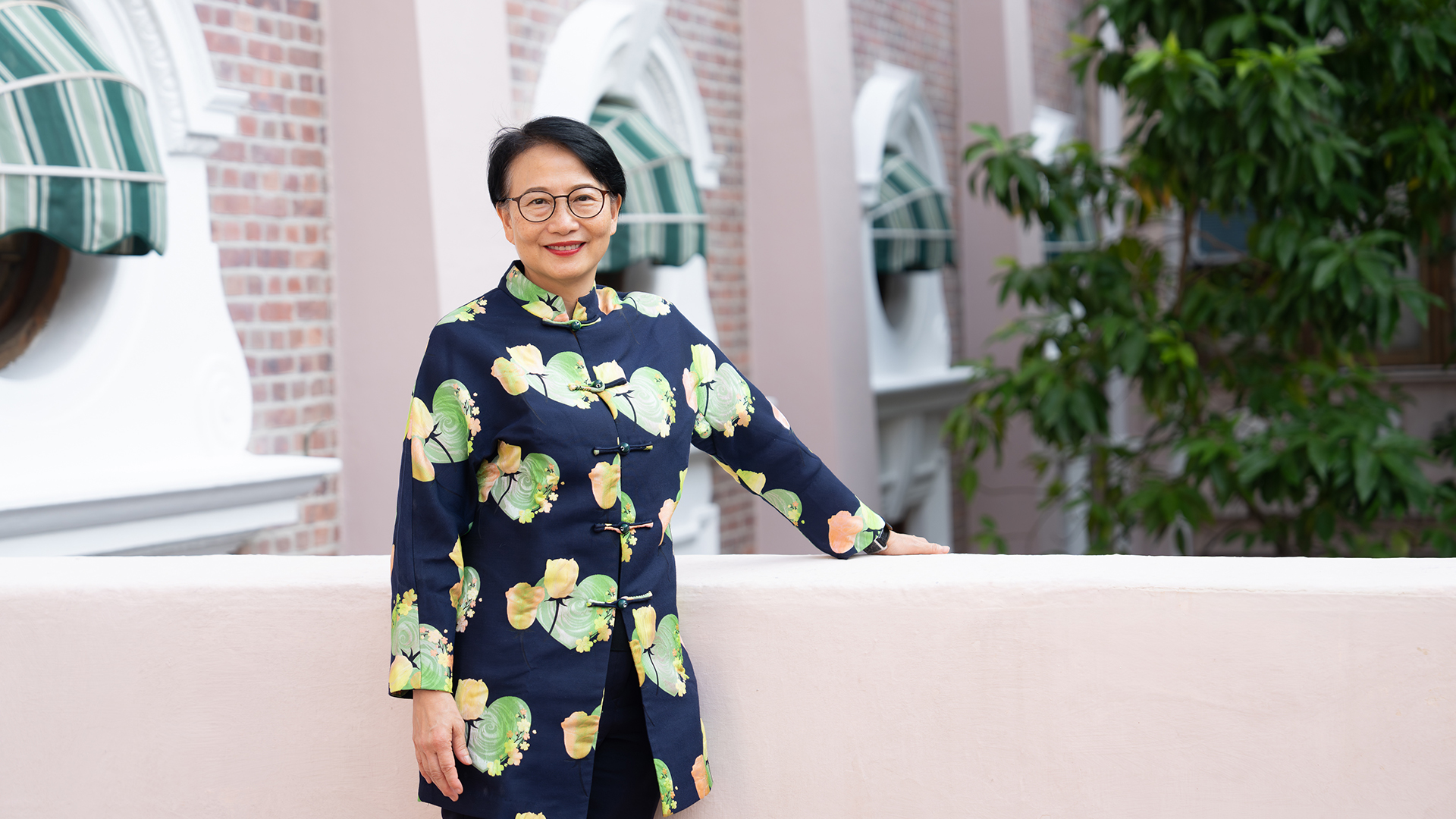
Mrs Cherry Tse Ling Kit-ching is a distinguished alumna of HKU and has recently taken on the role of Executive Vice-President (EVP) (Administration and Finance). She holds a Bachelor of Arts from HKU, a Master of Public Administration from Harvard University (Kennedy School of Government) and a Master of Education from the Chinese University of Hong Kong. Mrs Tse has a stellar track record in the Administrative Service of the Government of the Hong Kong Special Administrative Region (HKSAR) of the People’s Republic of China, and has served as Permanent Secretary for Education and Permanent Secretary for Home Affairs. Discover how the University influenced her and what her vision is for its administrative development.
Q: HKU is your alma mater – any memorable moments you could share with us?
A: My entire HKU journey was memorable, and even the path to joining the University felt right. I came from quite a grassroots background and was the first in my family to attend university. Going overseas to study wasn’t a feasible option. At the time, there were only two universities in Hong Kong: HKU and the Chinese University of Hong Kong, with the choice between them much influenced by the stream of post-Secondary 5 studies offered by the school. Since I had studied at an Anglo-Chinese school that prepared students for Advanced Level studies, the choice of HKU was very natural.
Very early on in secondary school, I had already wanted to study history, so that was what I majored in at HKU, taking a minor in English Literature. Many people seem to think that studying history is just details memorisation. But that would be missing the fun and the essence of it. I had learnt to approach history as if I were unravelling a drama or a novel. First and foremost is to grasp the context, then assess the perceptions, values and motivations of key historical figures and put myself into their shoes and those of the general public at the time, then I would be better able to feel how they felt. In fact, most of them were really behaving in quite understandable ways given the circumstances that they were in. This also facilitates an appreciation of historical trends.
I’ve always had fond memories of HKU. Those were very happy years for me. Even if I had a chance to relive my undergraduate days, I wouldn’t change a single thing! HKU has given me so much. In fact, I was able to fly on an airplane for the first time in my life because of HKU. I was fortunate enough to be chosen as the only HKU student representative to spend a month in Wales and London participating in a Commonwealth Youth Exchange Programme. It was an unforgettable experience.
I also remember fondly how caring my professors were. Fearing that I might trip over myself, the late Professor Leonard Kenneth Young, the then Head of the History Department and one of the Pro-Vice-Chancellors, suddenly knelt down in front of me and tied my loosened shoelace when I, a student activity organiser, invited him onto the stage to deliver an opening remark. He then gave me a pat on the shoulder and gently reminded me to tie my shoelaces well. How warm and touching!
Q: Your 38 years of service in the HKSAR Government covered a wide range of areas from housing and public finance to education. Why did you choose to enter the civil service?
A: I’ve always had a great sense of curiosity, and perhaps more to the point, I know that I can get bored easily if I have to do the same thing for years over and over again! So I enjoyed working in the Government’s Administrative Service Grade. The periodic postings meant that I had many jobs in the same job. I experienced changes in postings every three to five years – many a time, to an entirely different part of the Government. Though climbing a steep learning curve in a completely new area can be tough, this also makes life interesting and enriching, as over time, one’s knowledge becomes much broader.
Q: Any particularly challenging or memorable experiences from that time?
A: Actually, some of the greatest challenges also turned out to be the most valuable learning lessons for me. One of the more memorable experiences was the bar-benders strike in 2007. It lasted for 36 days, the second-longest strike in Hong Kong since World War II. I had just started my tenure as Commissioner for Labour when I was plunged into some very tough negotiations. The points that left the greatest impression on me were first, many a time, big problems arose out of lack of communication and miscommunication. Secondly, sometimes one should not take just a ‘task-oriented’ approach – we need to look beyond the current incident and probe why it happened and how we may forestall recurrence. After the strike, through reasoned discussion, the cycle and mechanism for salary revision were refined and emulated by other construction trades too. No industry-wide strike in the construction sector has taken place since then.
Q: What made you decide to take this role of EVP?
A: I retired from the civil service about three years ago. At the time, I had no intention of working full-time again, and was quite active doing volunteer work. I was approached several times about this EVP position, and eventually, I was touched by the sincerity of the President, the Provost, and the members of the Senior Management Team to whom I had spoken. I agreed to accept this challenge also because I regard it as a contribution to my alma mater, which has given me so much.
Q: How do you feel about AI and its role at the University?
A: I think AI is a double-edged sword. I’m still grappling with it. It certainly makes learning so much more efficient. You don’t need to memorise so much, and it facilitates data analysis. But I think we should all beware of becoming dependent on it. The crux of AI is an interplay of data, algorithms, and computing power. Taking in AI-generated information in an unquestioning manner could render one vulnerable to manipulation. Privacy and data leakage are also areas of concern.
Q: In the AI-age, is there anything that we should bear in mind?
A: I think a grateful mindset is very important. Life is full of uncertainty, and Hong Kong faces a lot of challenges, as indeed does every corner of the world. We cannot predict which occupations will thrive 10, 15 years from now, or which will disappear because of AI. So, HKU graduates will have to be adaptable and fend for themselves. But irrespective of their ups and downs in life, they have to appreciate that they are already a lot more fortunate than many others. A sense of abundance and inner peace start with gratitude. While striving for self-realisation and success, they should also be grateful for what they have.
Q: What do you anticipate as being your initial challenges in the EVP role?
A: Space, or more accurately, the lack of it. Even in my preliminary discussions with the President, members of the Senior Management Team and the academic staff that I’ve met so far, I’m impressed by how sincere they are in seeking to improve the learning environment for our students and attract exceptional faculty. Related to physical space is infrastructure. Something as basic as commuting to and from the campus already reveals many challenges. The long queues at the MTR exit have become a daily phenomenon. I have personally tried all the travel options myself in order to understand the situation better.
My sense of purpose is very clear: using resources wisely to provide an inspiring learning environment and better support for teaching and learning, research and students’ wholesome development.
Q: Does the way HKU is growing present particular administrative challenges?
A: Being a comprehensive university that embraces diversity is one of HKU’s greatest assets. We offer students a wide range of learning perspectives and a socially enriching environment where they can interact with people from different disciplines and backgrounds.
As knowledge evolves and grows, more and more interdisciplinary subjects and skills will spring up. New schools would need to be formed. Not only will there be additional need for space and resources, but the supporting administrative machinery will also grow bigger.
How can we enhance communication to make sure that individuals and individual units can work in their own niche areas in a very focussed manner, while still keeping the bigger picture in mind? For HKU (and indeed for any big organisations), staying coordinated while embracing diversity will present a great challenge.
That said, we always face problems in life and have to learn to enjoy life while solving them. Things often seem impossible until they are done. If you can’t get it done following the old path, try a new path. When there’s a will, there’s a way.