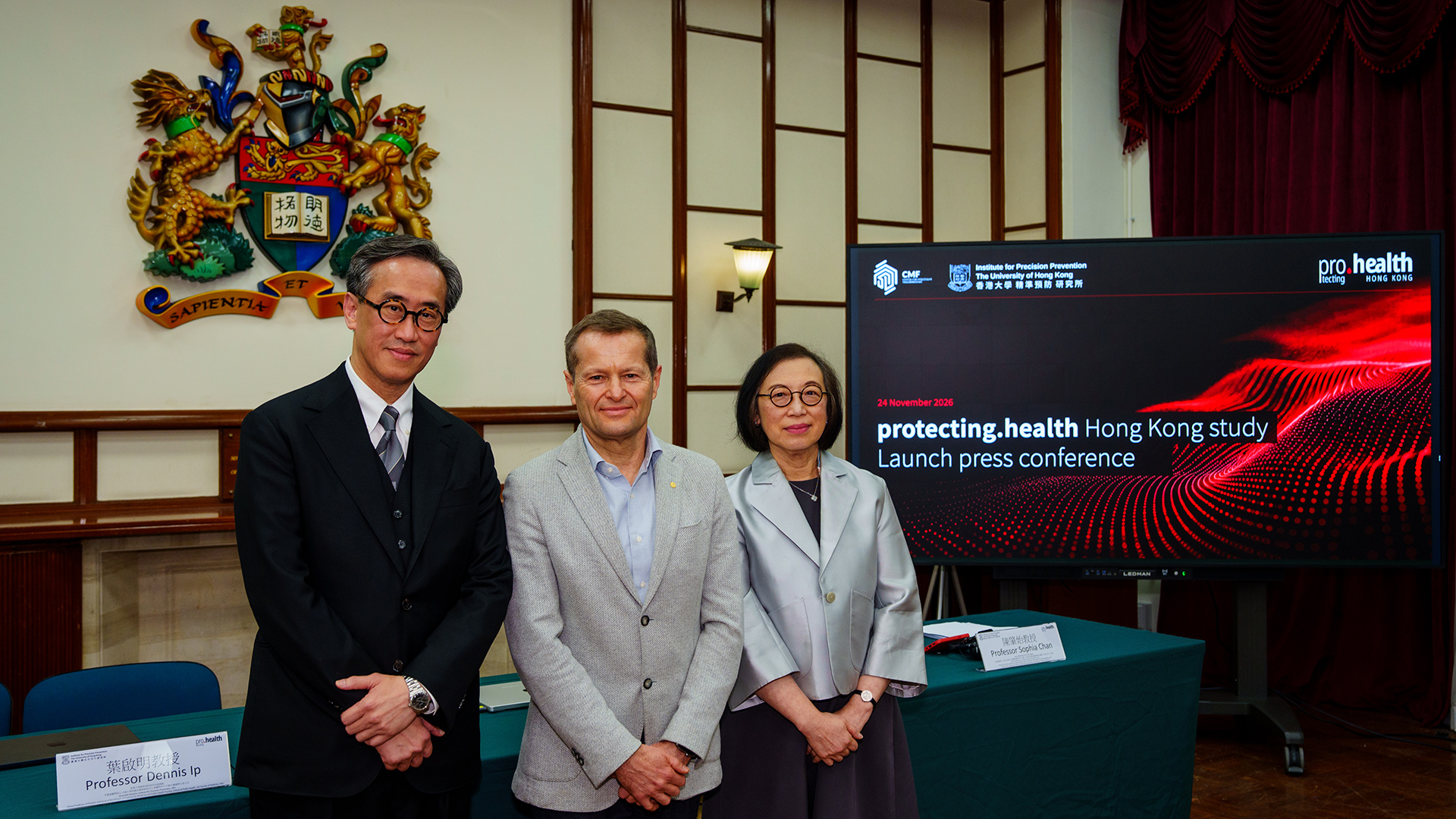
The Institute for Precision Prevention (IPP) at the University of Hong Kong has officially launched the Protecting.Health Hong Kong study, part of the global Protecting.Health initiative, marking a transformative milestone in the development of preventive medicine and public health research across Asia. ThisNovember, the ambitious scope of the multi-year cohort study was unveiled by the key figures of the Institute, including Professor Ferenc Krausz, 2023 Nobel Laureate in Physics, Director of the IPP, and HKU Chair Professor of Laser Physics, who is the Chief Principal Investigator spearheading the groundbreaking study. He was joined by Professor Sophia Chan, Chief Scientific Advisor of the IPP, Director of the HKU Primary Health Care Academy under the School of Public Health, and Director of the WHO Collaborating Centre for Health and Nursing Workforce Development in Primary Health Care; along with Professor Dennis Ip, Associate Director of the IPP, and Clinical Professor of Practice and Head of the HKU School of Public Health’s Division of Community Medicine and Public Health Practice, who will oversee the clinical execution and day-to-day operations of the programme.
At the core of the Protecting.Health philosophy is a decisive shift from medical cure to proactive prevention. Modern healthcare systems worldwide face unsustainable pressures from non-communicable diseases (NCDs), such as cancer, diabetes, cardiovascular diseases, and chronic respiratory diseases. While pharmaceutical and surgical interventions have advanced remarkably, treating chronic illnesses after diagnosis often yields diminishing returns and reduced quality of life. By identifying early biomarkers and modifiable risk factors years or even decades before symptoms appear, researchers aim to empower individuals and clinicians to intervene early, effectively disrupting the traditional landscape of ageing.
“Every year, 18 million people die, and many more lose their ability to work under the age of 70, caused by NCDs,” Professor Krausz noted. “Most of them are actually preventable with early detection. The tremendous loss of life and quality of life and the loss of immense resources, implied by late diagnosis of chronic conditions, can only be mitigated by preventive care.”
Rather than waiting for illnesses to manifest, the Protecting.Health initiative seeks to map the complex biological and lifestyle determinants that influence long-term wellness. This is especially relevant to the healthcare system in Hong Kong and its demographics. “NCDs and our ageing population remains a major challenge and burden for our healthcare system, and on individuals as well as families,” said Professor Sophia Chan. “Hong Kong has a heavily subsidised public healthcare system. Therefore, the more people have diseases, the larger the burden will be for the government.”
“This research supports Hong Kong’s crucial shift towards primary healthcare and preventive medicine, translating cutting-edge science into direct benefits for our local community,” she added. “Detecting molecular changes years before symptoms appear is consistent with the primary healthcare role. As the first and repeated point of contact, early risk signals could be acted upon in community settings before the patients require specialist or hospital care.”
In contemporary, one-size-fits-all healthcare, in vitro diagnostics measures molecular levels by single analytics, and compares them with populational based reference ranges. Currently available routine markers are deemed not sufficient for comprehensive health monitoring.
However, at the core of the Protecting.Health study is Electric-Field Molecular Fingerprinting, a technology developed from Professor Krausz’s Nobel Prize-winning research in fundamental physics. By using infrared light to read molecular patterns in blood, the technology can detect the earliest molecular signals of disease while an individual is still healthy.
“Next generation molecular diagnostics that are able to access hundreds of molecular parameters in a single measurement, and a healthcare modality that enables us to use our own previously measured values as reference – these are the keys to a new type of healthcare,” explained Professor Krausz. “We hypothesise that human blood carries the molecular information needed for creating a protective shield against NCDs.”
Aiming to recruit 15,000 local participants for 10 years of active follow-up, followed by another 10 years of health data collection, the study is targeting healthy adults aged 40 to 70 in Hong Kong. Participants will be assessed for overall health risk and may be grouped into lower- and higher-risk categories based on cardiovascular risk factors, smoking history and family history. The core objective is to develop a highly accessible, cost-effective, and personalised health screening algorithm capable of predicting disease progression before symptoms appear. This will require regular blood samples to be taken from participants of the study. “Detecting disease before symptoms manifest, requires us to donate blood repeatedly while we feel perfectly healthy,” said Professor Krausz. “This is the price we will have to pay for protecting our health, more efficiency, and the price we have to pay for establishing this new healthcare modality.”
The clinical phase of the study has already welcomed its first participants – The Honourable Bernard Charnwut Chan, Dr the Honourable Ko Wing-man, and Dr the Honourable Lam Ching-choi – who have completed their baseline clinical assessments and blood sample collections, as a first step to establish their personal molecular baselines. Mr Chan explained his willingness to trust the study at HKU by saying, “We have the perfect combination of the right professionals and the right institution to back it up, so I would not have any doubts about signing up.” Dr Lam added, “If this research has a positive outcome, I think it’s going to disrupt the whole landscape of ageing.”
HKU President and Vice-Chancellor Professor Xiang Zhang affirmed the University’s strong support for the initiative. “We celebrate this very important milestone as Professor Ferenc Krausz passionately launches this vital initiative with the support of our colleagues in medicine,” said Professor Zhang. “He is a scientific giant who has crossed disciplinary boundaries into medicine to make a profound impact on human life and health.”
The Protecting.Health Hong Kong study is part of the international Protecting.Health Initiative led by Professor Krausz. It brings together the HKU Institute for Precision Prevention with research partners in Hungary, Germany and Ghana, building on experience from the Health for Hungary study, which has involved more than 13,000 participants. The Hong Kong cohort will provide a vital Asian perspective, helping to ensure the approach is relevant across different populations and contributing to a globally coordinated vision of personalised preventative healthcare.
“Looking back, a single guiding thread has shaped my scientific journey: the drive to make the invisible visible again and again,” said Professor Krausz. “Modern medicine has become remarkably good at repairing the car after the engine breaks down. But it would be far more efficient if we could recognise the fault while the engine is still running well. That is exactly our ambition.”